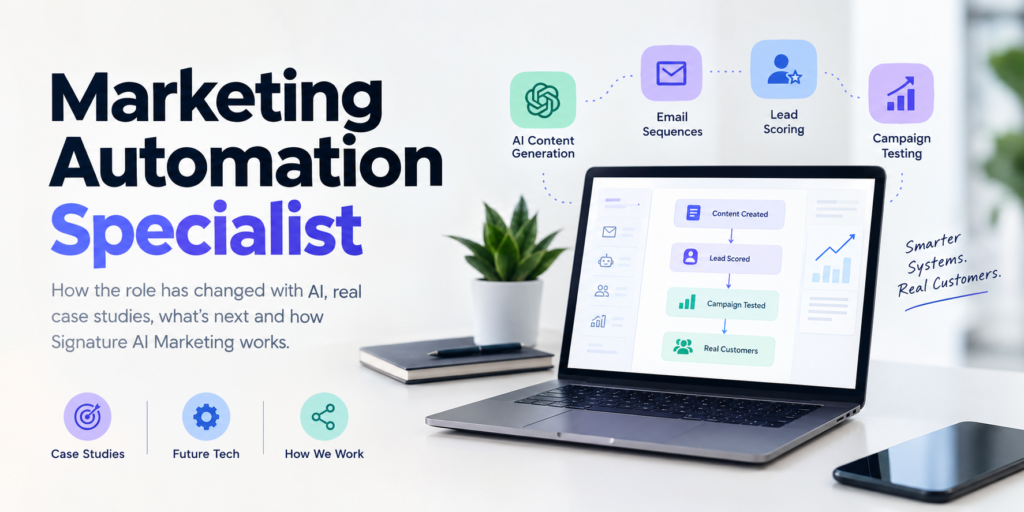
A marketing automation specialist used to be the person who built email sequences. By 2027 the job looks different. AI now drafts content, scores leads and tests campaigns, so the specialist’s real work is designing the system that connects them and checking that it serves real customers.
This guide explains what a marketing automation specialist does in the AI era, walks through three documented case studies, looks at the technologies arriving next, and shows how Signature AI Marketing works. Every figure links to its source.
What Does a Marketing Automation Specialist Do in the AI Era?
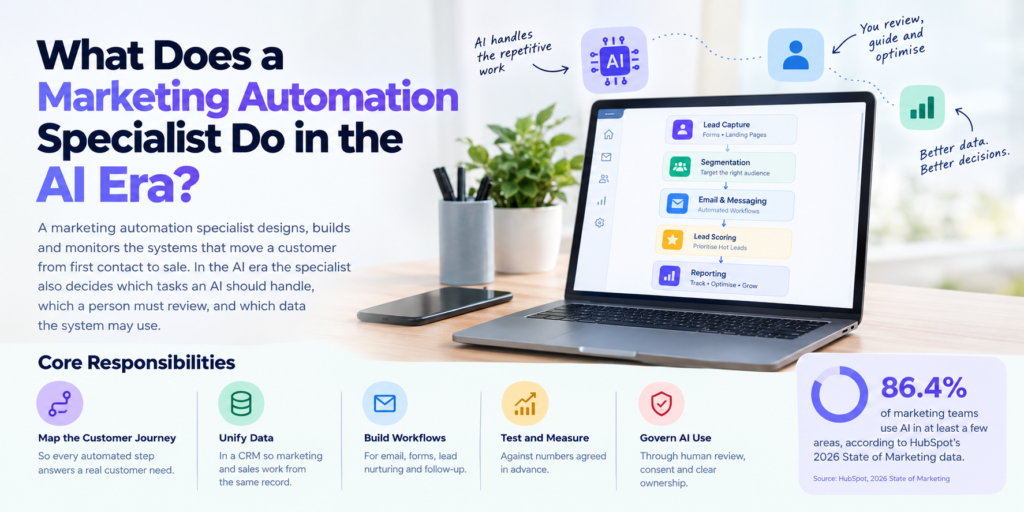
A marketing automation specialist designs, builds and monitors the systems that move a customer from first contact to sale. That covers lead capture, segmentation, email and messaging workflows, lead scoring and reporting. In the AI era the specialist also decides which tasks an AI should handle, which a person must review, and which data the system may use.
Core responsibilities of a marketing automation specialist include:
- Mapping the customer journey so every automated step answers a real customer need.
- Unifying data in a CRM so marketing and sales work from the same record.
- Building workflows for email, forms, lead nurturing and follow-up.
- Testing and measuring against numbers agreed in advance.
- Governing AI use through human review, consent and clear ownership.
The skill is in demand because adoption is already widespread. HubSpot’s 2026 State of Marketing data shows that 86.4% of marketing teams use AI in at least a few areas. When everyone has the tools, the advantage goes to the marketing automation specialist who designs the system well.
3 Case Studies in AI-Assisted Marketing Automation
The three examples below come from published sources. The results are reported by the companies or their partners, and the sources do not always explain how they were measured. Treat them as evidence of what is possible, not as guaranteed outcomes.
Case Study 1: ReFUEL4 Turns Lead Volume Into Qualified Leads
ReFUEL4 is a Singapore-based creative company that runs an AI-driven platform for campaign creative performance. As it grew, marketing passed leads of mixed quality to sales, and the sales team spent time chasing prospects who were not ready to buy.
The company adopted HubSpot, built workflows to automate email campaigns, captured leads through forms on landing pages and paid ads, and used the CRM as the shared source of truth for marketing and sales. According to HubSpot’s case study, average marketing-qualified leads per month rose 222% and average meetings booked per month rose 160%. Marketing spend also increased, and the case study does not state the baseline period.
Case Study 2: Klarna Cuts Image Production From Six Weeks to Seven Days
Klarna used generative AI tools across its marketing. Marketing Dive reported in May 2024, citing a Klarna press release, that the company cut sales and marketing spend by 11% in the first quarter of 2024 while running more campaigns. The image development cycle fell from six weeks to seven days, the company saved $6 million in image production costs, and spending on marketing suppliers dropped 25%.
The lesson is that automating repeatable production work frees budget and time. Strategy, messaging and brand decisions still need people, and a content marketing platform or workflow tool only helps when those decisions are clear first. Setting those rules is part of the marketing automation specialist’s job.
Case Study 3: Unilever Uses Digital Twins for Digital Branding Consistency
Unilever builds photorealistic 3D digital twins of its products from CAD data, using NVIDIA Omniverse and OpenUSD, so teams can produce imagery for different markets, languages and lighting setups from one master asset. NVIDIA’s case study names Dove, Knorr and Vaseline among the portfolio. The figures it reports are product imagery created two times faster, a 50% reduction in production costs, 100% brand consistency across touchpoints and a 5:1 reduction in content duplication.
This is a vendor-published case study with self-reported figures. It still shows that digital branding at scale depends on one trusted master source, not dozens of edited copies.
What the Three Cases Share
- A clear problem first. Low-quality leads, slow image production and inconsistent product imagery were each defined before tools were chosen.
- One source of truth. A CRM, a central workflow and a digital twin each gave teams one reliable version.
- Automation for repeatable work. People kept the strategy and brand judgement.
- Specific numbers. Each team measured outcomes, not activity.
None of these results came from tools alone. They came from design, which is the craft of a good marketing automation specialist.
Digital Branding in an Automated World
Digital branding is how a brand looks, sounds and behaves across every digital channel. Automation makes it harder and more important. When AI can produce content in seconds, a brand without a clear point of view blends into the noise. HubSpot’s 2026 State of Marketing report describes AI as the baseline, not the differentiator and warns that brands without a clear point of view get lost as AI floods the market with content.
Practical steps for automated digital branding:
- Write brand voice, claims and style rules in plain language that tools and people can both follow.
- Keep approved assets, logos and product facts in one shared library.
- Add a human review step before automated content goes live.
- Check outputs regularly against the brand rules.
A marketing automation specialist should build these checks into the workflow itself, so that digital branding is protected by default.
The benefits of content marketing, such as steady discovery and trust, last only when content stays consistent and useful. Our brand and messaging work focuses on that foundation.
What an AI SEO Company Should Plan for Next
An AI SEO company now has to think beyond ranking in a list of links. HubSpot reports that half of consumers use AI-powered search and half of Google searches include an AI overview. Ahrefs found that US search volume for “AI visibility” rose 258% year over year.
Google’s guidance is reassuring on one point: there are no additional requirements to appear in AI Overviews or AI Mode, so SEO fundamentals still apply. On top of that sit AEO, GEO and AAO, which aim to make a brand the answer, the citation and, when an AI agent acts for a user, the choice. Kalicube describes AAO as Assistive Agent Optimization, a term Jason Barnard coined in 2025. A capable AI SEO company covers all these layers and tracks AI referrals and citations alongside rankings. Our SEO and AI visibility service is built this way. A marketing automation specialist then connects those results to the lead workflow, so visibility turns into enquiries.
4 Emerging Technologies a Marketing Automation Specialist Should Watch
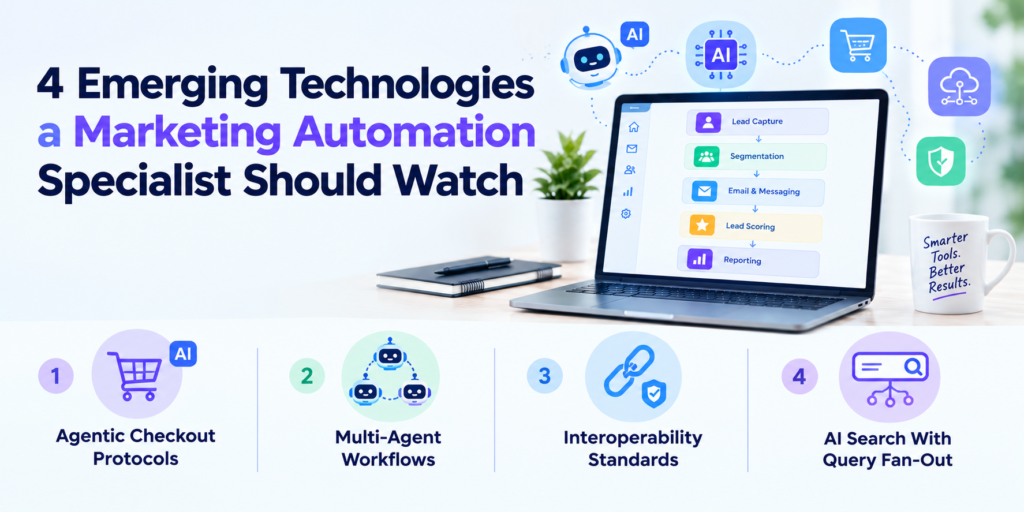
1. Agentic Checkout Protocols
Two open standards are letting AI agents complete purchases. Google announced the Universal Commerce Protocol on 11 January 2026, designed so agents can handle discovery, checkout and post-purchase support. It was developed with retail and commerce platforms including Shopify, Etsy, Wayfair, Target and Walmart. Stripe and OpenAI released the Agentic Commerce Protocol with Instant Checkout in ChatGPT on 29 September 2025. Merchants integrate once and keep control of what they sell, how their brand appears and how orders are fulfilled.
2. Multi-Agent Workflows
Gartner predicts that by 2027 one-third of agentic AI implementations will combine agents with different skills, with multiagent ecosystems by 2029. Its marketing predictions add that 60% of brands will use agentic AI for streamlined one-to-one interactions by 2028. Gartner also warns that over 40% of agentic AI projects will be cancelled by the end of 2027 because of costs, unclear value or weak risk controls. The answer is to give each agent a narrow task, clean data and a measurable goal.
3. Interoperability Standards
The Universal Commerce Protocol is designed to work with complementary standards, including the Agent Payments Protocol, Agent2Agent and the Model Context Protocol. Skift notes it is meant to replace one-off integrations between different AI assistants with a common setup. For a marketing automation specialist, that points to workflows that connect across platforms instead of living inside one app.
4. AI Search With Query Fan-Out
Google says AI Overviews and AI Mode may use “query fan-out”, issuing multiple related searches across subtopics and data sources to build a response. That is one more reason to cover a topic in depth, with clear subtopics and consistent facts, instead of publishing thin pages.
How to Choose a Marketing Automation Specialist
Whether you hire a freelancer, an agency or an in-house marketing automation specialist, ask these questions first:
- Which problem will you solve first? A good marketing automation specialist starts with a defined problem, not a tool.
- How will we measure it? Ask for the baseline, the target and the reporting rhythm.
- Where does our data live? Clean, consented data matters more than the platform.
- Where do people stay in the loop? Reviews should cover claims, digital branding and anything customers see.
- How will search and AI visibility be handled? Some businesses add an AI SEO company, others cover it in-house. Either way, one owner should keep content, SEO and automation consistent.
How Signature AI Marketing Works
Signature AI Marketing describes itself as a growth intelligence company that combines artificial intelligence, behavioural science and data analytics. Its approach is strategy before execution:
- Diagnose. We start with a growth audit: a read of your current acquisition economics, the two or three highest-leverage moves, and an honest view on whether we are a fit.
- Study before acting. We study markets, audiences, information flows and emerging technologies before recommending action.
- Build the system. AI and automation support research, strategy and execution across campaign automation, content, SEO, paid and social, with data and analytics tracking results.
- Keep experts in charge. Strategy and concept development are led by experienced professionals, including PhD-level expertise in relevant disciplines.
- Report what matters. We report on the numbers that move the business, not vanity metrics.
We operate as a fully virtual and automated organisation for higher and strategic work, so clients get a defined problem and a measurable result rather than a list of services. To see how this could apply to your business, book a growth audit.
Frequently Asked Questions About Marketing Automation Specialists
What does a marketing automation specialist do?
A marketing automation specialist designs, builds and monitors automated systems for lead capture, segmentation, email and messaging workflows, scoring and reporting. In the AI era they also decide where AI and human review fit.
How much can marketing automation improve results?
Published results vary. ReFUEL4 reported a 222% rise in monthly marketing-qualified leads and a 160% rise in monthly meetings booked after adopting HubSpot workflows and a shared CRM. Results depend on starting point, data quality and strategy, so measure your own baseline first.
What is digital branding and why does it matter with AI?
Digital branding is the consistent look, voice and behaviour of a brand across digital channels. It matters more with AI because automated content can drift off-brand unless clear rules, one asset library and human review are in place.
What does an AI SEO company do differently from a traditional SEO agency?
An AI SEO company keeps the SEO fundamentals and adds work for AI answers and agents: AEO, GEO and AAO, consistent business information, and tracking of AI referrals and citations.
When should a business hire a marketing automation specialist?
Hire one when leads slip between marketing and sales, manual follow-up slows response times, or AI tools are used without shared rules. ReFUEL4’s problem of mixed-quality leads reaching sales is a typical trigger for bringing in a marketing automation specialist.
Which emerging technologies should marketers watch?
Watch agentic checkout protocols such as the Universal Commerce Protocol and the Agentic Commerce Protocol, multi-agent workflows, interoperability standards and AI search features that use query fan-out. Pilot each with one narrow, measurable use case.
How does Signature AI Marketing start a project?
With a growth audit that reviews your acquisition economics, identifies two or three high-leverage moves and gives an honest view on whether the fit is right.