AI in Marketing by 2027: The Real Advantage Will Be Learning Faster
AI in marketing by 2027 will do much more than create advertisements. It will help businesses understand customers, test ideas, improve campaigns, and learn from results.
But using AI is not the same as using it intelligently.
A business can produce thousands of posts and still fail to understand its customers. Another can use AI to discover what people need, why they hesitate to buy, and what makes them trust a brand. The second business may have the greater advantage.
This guide covers five changes to watch in AI in marketing, the information foundation that makes them work, and what it takes to stay visible when customers ask AI assistants, and soon AI agents, to choose for them.
What Will AI in Marketing Look Like by 2027?
By 2027, AI in marketing will move from producing content to producing understanding. Leading businesses will use AI to analyse customer behaviour, run faster tests, connect research, content and performance through AI agents, and check synthetic insights against real people, all under clear human accountability.
Adoption of AI in marketing is already close to universal. HubSpot’s 2026 State of Marketing research, based on more than 1,500 marketers, found that 86.4% of marketing teams use AI in at least a few areas. The report itself describes AI as the baseline, not the differentiator. When nearly everyone has the same tools, the advantage moves to how well a business uses them.
Why Learning Faster Is the Real Advantage in AI Marketing
More Content Is Not More Growth
The biggest mistake businesses can make is assuming that producing more content automatically means achieving more growth. In AI in marketing, volume is now easy to produce. HubSpot notes that as AI floods the market with content, brands without a clear point of view get lost. Understanding is what remains scarce.
Turn Information Into Insight, and Insight Into Decisions
The future belongs to businesses that turn information into insight, insight into decisions, and decisions into measurable results. AI can accelerate every step of that loop:
Information: gather customer questions, behaviour and feedback in one place.
Insight: find patterns in what people need, why they hesitate and what builds trust.
Decisions: choose what to test, change or stop.
Results: measure outcomes, then feed them into the next decision.
Strategy determines where to go. Evidence helps determine what works. Human judgement keeps the system grounded.
5 Shifts Shaping AI in Marketing by 2027
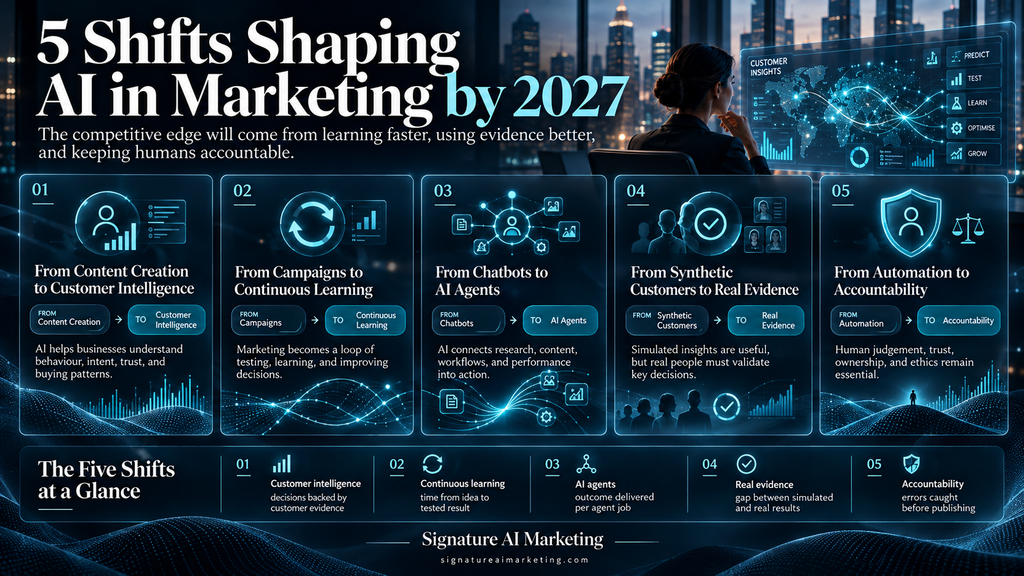
Shift 1: From Content Creation to Customer Intelligence
AI will help businesses analyse customer behaviour, preferences, questions, and buying patterns. This is marketing intelligence in practice: turning raw signals into answers about what customers want next, where they stall, and which proof earns their trust.
The most useful signals are often already inside your business: sales call notes, support tickets, reviews, on-site search terms, and the questions people ask before they buy. Market intelligence tools can add competitor and category data, but first-party evidence is the one asset a rival cannot copy.
Shift 2: From Campaigns to Continuous Learning
Faster testing and feedback will help marketers improve their decisions instead of relying on assumptions. A campaign stops being a launch followed by a final report and becomes a loop:
State a clear hypothesis about the customer.
Test it with a small, fast experiment.
Read the result against a measure agreed in advance.
Keep, change or drop the idea, and record what you learned.
The record matters most. A team that writes down what it learns compounds its advantage every week.
Shift 3: From Chatbots to AI Agents
AI systems will increasingly connect research, content production, campaign management, and performance analysis. Gartner predicts that 40% of enterprise applications will include task-specific AI agents by the end of 2026, and that by 2027 one-third of agentic AI implementations will combine agents with different skills.
A note of caution is warranted. Gartner also predicts that over 40% of agentic AI projects will be cancelled by the end of 2027 because of escalating costs, unclear business value or inadequate risk controls. The practical lesson is to give an agent one narrow job, a clean data source and a measurable outcome before widening its role. Businesses ready to build those workflows can start with campaign automation tied to a defined result.
Shift 4: From Synthetic Customers to Real Evidence
AI can simulate customer responses, but real people must validate important decisions about demand and purchasing behaviour. The research supports both the promise and the limit. A study in the NIM Marketing Intelligence Review found that synthetic respondents matched real participants’ choices about 79% of the time, yet overstated brand attitudes and showed less variation than real people. Separately, research by PyMC Labs and Colgate-Palmolive, reported by Research Live, found that synthetic respondents reached 90% of human test-retest reliability in concept testing when paired with suitable elicitation methods.
Use synthetic customers to explore ideas early and sharpen your questions. Use real customers to decide what to build, price and launch.
Shift 5: From Automation to Accountability
AI can accelerate marketing, but human judgement, creativity, ethics, and trust remain essential. Trust is also fragile. Gartner’s marketing predictions note that nearly two-thirds of consumers expect generative AI shopping tools to make biased recommendations. And when OpenAI began rolling out ads in ChatGPT in February 2026, Adweek’s trend analysis pointed out that people now have to tell organic recommendations from sponsored ones.
Accountability in practice means naming an owner for every AI workflow, recording which data it used, verifying factual claims before publishing, and disclosing AI involvement where it affects trust. It also means protecting the human voice of the brand, which is where brand and messaging work earns its place.
The Five Shifts at a Glance
ShiftFromToWhat to measure1Content creationCustomer intelligenceShare of decisions backed by customer evidence2CampaignsContinuous learningTime from idea to tested result3ChatbotsAI agentsOutcome delivered per agent job4Synthetic customersReal evidenceGap between simulated and real results5AutomationAccountabilityErrors caught before publishing
Marketing Information Management: The Foundation Behind Faster Learning
Marketing information management is the practice of collecting, organising, governing and sharing marketing data so that teams and AI tools work from one reliable picture of customers and performance.
AI learns from what it is given. If customer data lives in five tools with five definitions of a lead, an agent will scale the confusion instead of fixing it. A strong foundation has five parts:
One customer view: link CRM, website, email, ads and support data under shared definitions.
A single source of truth: agree on names, metrics and ownership for every number.
Consent and privacy: collect first-party data openly and use it within what customers agreed to.
Feedback capture: log the questions, objections and reasons for hesitation that customers actually voice.
Measurement rules: decide in advance how success is judged, so every test produces a clear answer.
Teams that get this right learn faster because every experiment feeds the same memory. This is the layer our data and analytics work puts in place before any agent is switched on.
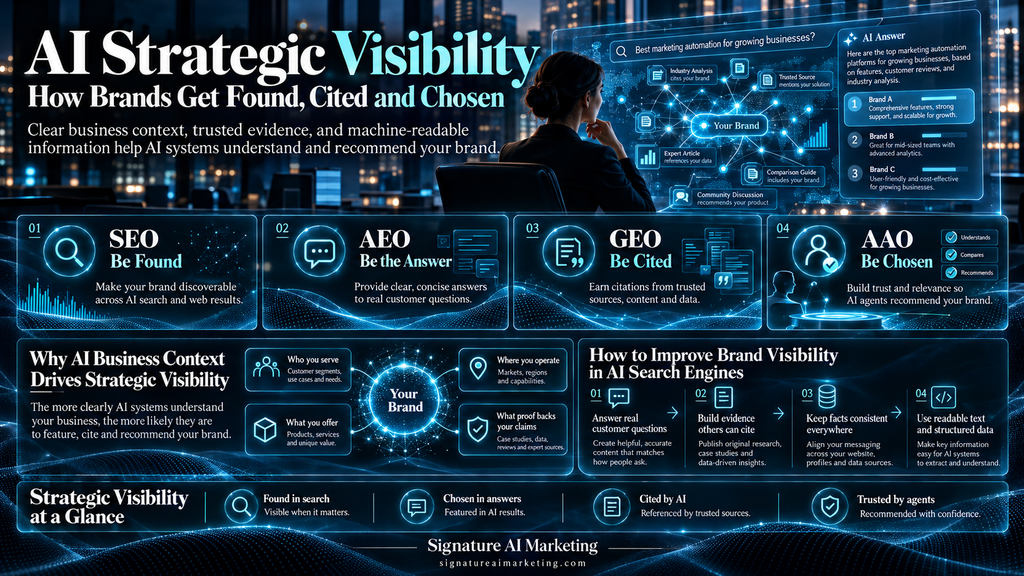
AI Strategic Visibility: How Brands Get Found, Cited and Chosen
AI strategic visibility is how clearly and consistently AI systems understand, trust and recommend your brand when people ask questions or hand tasks to an agent. At Signature AI Marketing we use the term for a goal beyond ranking: being found, cited and chosen.
AI in marketing now includes visibility inside AI answers, and the scale is no longer marginal. HubSpot reports that half of consumers now use AI-powered search and that half of Google searches include an AI overview. Ahrefs found that US search volume for “AI visibility” rose 258% year over year.
From SEO to AEO, GEO and AAO
DisciplineFull nameGoalQuestion it answersSEOSearch Engine OptimizationBe foundHow do we rank in search results?AEOAnswer Engine OptimizationBe the answerHow do we become the direct answer?GEOGenerative Engine OptimizationBe citedHow do we appear in AI-generated responses?AAOAssistive Agent OptimizationBe chosenHow does an agent pick us when no human is in the loop?
AAO is the newest layer. Jason Barnard of Kalicube coined Assistive Agent Optimization in 2025 and, by his own account, Search Engine Land published his case for it on 24 February 2026. The idea is simple. AI agents increasingly act for users by comparing, booking and buying, so being mentioned is not enough. A brand has to be understood, trusted and actionable enough to be selected. The terminology is still settling, but the direction is consistent: from being found, to being the answer, to being chosen.
One honest caveat keeps this practical. Google states that there are no additional requirements to appear in AI Overviews or AI Mode, and that no special schema is needed. AEO, GEO and AAO are best treated as extensions of strong SEO, not replacements for it.
Why AI Business Context Drives Strategic Visibility
AI systems recommend what they can understand. AI business context means the plain facts that let a system place your brand: who you serve, what you offer, where you operate, how you differ, and what proof backs your claims. When that context is scattered, contradictory or buried, an AI system has little to work with and may choose a competitor it understands better.
You can strengthen it in four ways:
Publish one authoritative page, often called an entity home, that states your brand, people, services and proof clearly.
Keep important information in readable text rather than locked inside images or scripts.
Make structured data match the visible text on the page.
Keep facts consistent across your website, profiles, directories and reviews.
How to Improve Brand Visibility in AI Search Engines
Answer real customer questions directly. Use a clear heading and give a short, factual answer first.
Build evidence others can cite. Original research, case results, expert credentials, reviews and press mentions all count.
Cover a topic in depth. One thorough page beats several thin pages repeating the same phrase.
Keep pages crawlable, fast and indexable. Eligibility for Google’s AI features rests on normal Search requirements.
Track the right signals. Watch AI referral traffic, brand mentions and citations in AI answers, and conversions from those visits.
Our SEO and AI visibility service applies this approach across traditional search and AI-powered platforms.
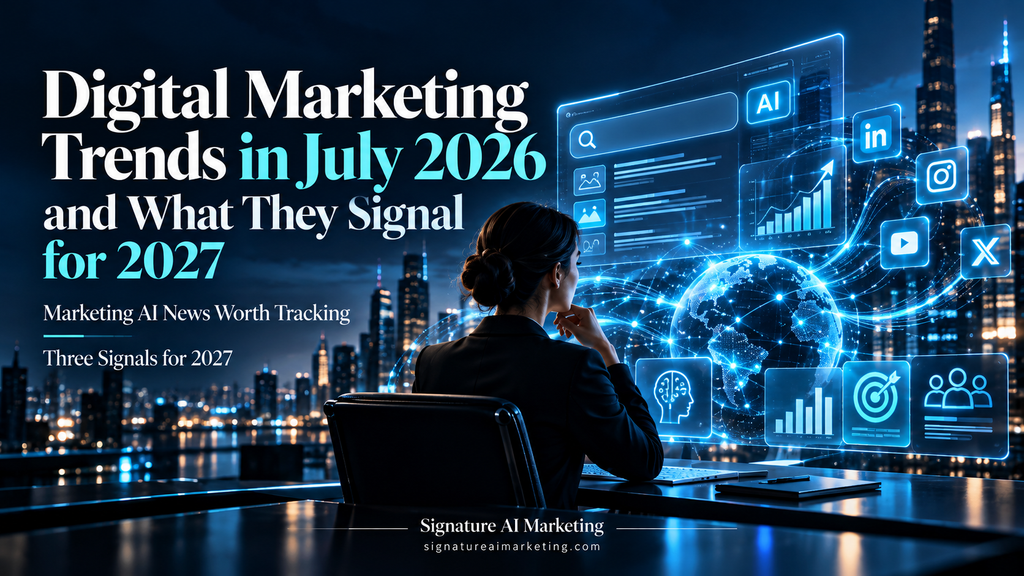
Digital Marketing Trends in July 2026 and What They Signal for 2027
Trend reports published through mid-2026 point the same way: AI in marketing is moving from experiments to everyday infrastructure, and each trend supports the five shifts above.
Marketing AI News Worth Tracking
Agents are learning to shop. On 11 January 2026 Google introduced the Universal Commerce Protocol, an open standard that lets AI agents handle discovery, checkout and post-purchase support, with checkout planned for Google’s AI Mode and the Gemini app.
Ads are entering AI answers. OpenAI began rolling out ads in ChatGPT in February 2026, according to Adweek’s analysis.
Agent demand is rising. Ahrefs reports that US searches for “agentic commerce” grew 464% year over year to 5,600 a month.
Shoppers are cautious. A ChannelEngine study, reported by Techloy, found only 17% of shoppers feel comfortable letting AI complete a purchase.
Three Signals for 2027
Search is spreading across AI answers, social platforms and communities, so visibility must be earned in more places.
Agents are entering the buying journey, so trustworthy, machine-readable information becomes part of marketing.
Human point of view is the differentiator, because everyone can now generate content.
Marketing Research Topics Worth Exploring Before 2027
If learning faster is the advantage, research is the engine. Strong marketing research topics for AI in marketing over the year ahead include:
Which questions customers ask AI assistants before they shortlist a brand.
What makes a buyer hesitate at the final step, and which proof removes the doubt.
Which trust signals matter most in your category: reviews, expert credentials, guarantees or case evidence.
How closely synthetic respondents match real customers in your market.
Where AI-generated content helps your brand and where it makes you look generic.
How customers react when they learn that AI was involved.
What customers will, and will not, delegate to an AI agent.
Which first-party data sources best predict repeat purchase.
Each topic can start with AI-assisted analysis of data you already hold, then be confirmed with real customers.
When to Work With an AI Marketing Consultant
An AI marketing consultant is most useful when the problem is not a missing tool but a missing system. Common signs include:
You publish often but cannot say what customers have taught you.
Customer data sits in separate tools with different definitions.
AI pilots have no owner and no measure of success.
Your brand rarely appears when people ask AI assistants about your category.
Leadership wants speed without losing trust.
AI in marketing pays off when a good consultant puts strategy before execution, tests ideas against evidence, and keeps humans accountable for the result. At Signature AI Marketing, we believe the next competitive advantage is not simply creating more content. It is learning faster, understanding customers better, and creating experiences that feel genuinely human. You can read more about who we are and how our strategic communication work puts strategy first.
The Future Belongs to Businesses That Learn Faster
The next phase of AI in marketing will reward learning over volume. The future belongs to businesses that turn information into insight, insight into decisions, and decisions into measurable results. AI can accelerate this process. Strategy determines where to go. Evidence helps determine what works. Human judgement keeps the system grounded.
Where intelligence becomes influence, the winners will be the ones who kept learning. If you want a working diagnosis of where your growth is leaking, book a growth audit with our team. For more insights, visit our Blogs & News page.
Frequently Asked Questions About AI in Marketing
What is AI in marketing?
AI in marketing is the use of artificial intelligence to understand customers, create and personalise content, test campaigns, automate workflows and measure results. By 2027 its biggest value will shift from producing content to producing insight, helping businesses learn faster from customer behaviour and campaign performance.
How will AI change marketing by 2027?
Five changes stand out: from content creation to customer intelligence, from campaigns to continuous learning, from chatbots to AI agents, from synthetic customers to real evidence, and from automation to accountability. The common thread is that evidence and human judgement matter more as AI makes output cheap.
What is an appropriate task for using generative AI in marketing?
Good tasks are those where AI speeds up work that a person can review: drafting content variations, summarising customer feedback, grouping survey comments, generating test ideas and preparing first drafts of reports. Final claims, brand voice, pricing and decisions about real demand should stay with people and real customer evidence.
What is AAO, and how is it different from SEO, AEO and GEO?
AAO stands for Assistive Agent Optimization. It is the practice of making your brand understood and trusted enough that AI agents acting for a user choose it to complete a task. SEO aims to be found, AEO to be the answer, GEO to be cited in AI-generated responses, and AAO to be chosen.
What is AI strategic visibility?
AI strategic visibility is how clearly and consistently AI systems understand, trust and recommend your brand. It combines strong SEO, clear business context, consistent facts, third-party proof, and measurement of AI referrals and citations.
How can a brand improve visibility in AI search engines?
Start with fundamentals: crawlable, fast pages with helpful, people-first content. Add a clear entity home page, direct answers to customer questions, structured data that matches visible text, and external proof such as reviews and mentions. Google states that no special extra markup is required to appear in its AI features.
Can synthetic customers replace real customer research?
Not for important decisions. Studies show synthetic respondents can approximate real results in some tests, but they can overstate brand attitudes and show less variation than people do. Use them to explore early ideas, then validate demand, pricing and purchase behaviour with real customers.
What is marketing information management?
Marketing information management is the practice of collecting, organising, governing and sharing marketing data so teams and AI tools use one reliable view of customers and performance. It rests on shared definitions, consent-aware first-party data, captured customer feedback and clear measurement rules.