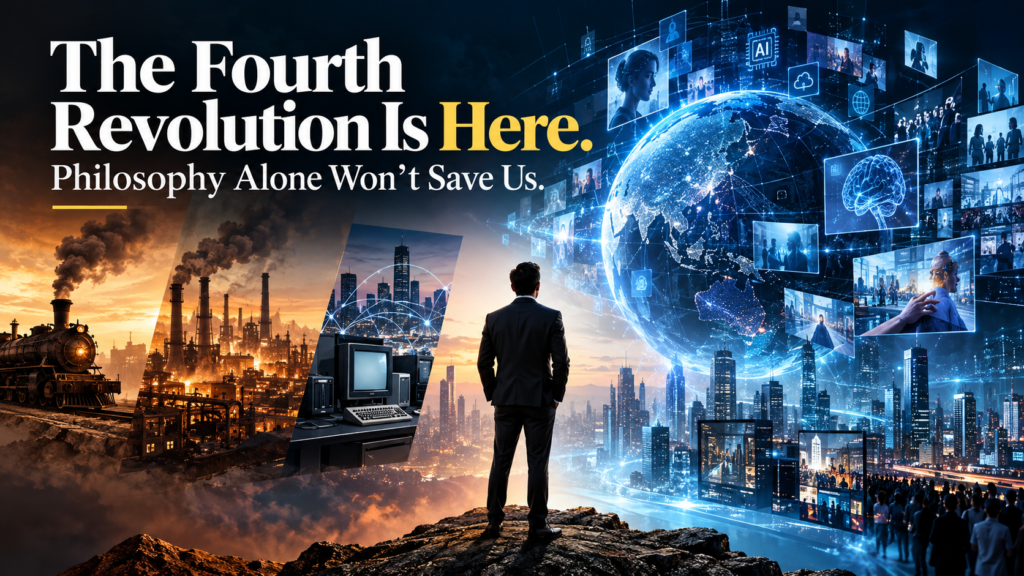
The Fourth Revolution Is Already Here
We are living through the Fourth Revolution.
It is not the Industrial Revolution of steam, machines, and steel. Nor is it simply the digital revolution of computers, software, and global networks.
This revolution is about information itself.
Human life, economic activity, political power, business competition, national security, and even personal identity are becoming increasingly dependent on the continuous creation, movement, filtering, interpretation, and manipulation of data.
Information is no longer something that merely supports society.
It is becoming the environment in which society operates.
Philosophers of information, most notably Luciano Floridi, have provided an important intellectual framework for understanding this transformation. Human beings can increasingly be understood as informational organisms operating within an interconnected infosphere.
We are entering what Floridi describes as hyperhistory—an era in which societies can no longer function independently of information and communication technologies.
The diagnosis is powerful.
But diagnosis alone is not enough.
The Missing Link Between Philosophy and Action
Much of the literature surrounding the Fourth Revolution performs an essential intellectual task: it explains how technology is transforming humanity’s relationship with information.
It identifies the rise of algorithms, digital identities, artificial intelligence, automated decision-making, information ecosystems, and new forms of technological power.
But there remains a major gap.
After describing the transformation, what should governments, businesses, entrepreneurs, strategists, and ordinary citizens actually do about it?
Understanding the infosphere does not automatically tell an institution how to compete within it.
Recognizing the power of algorithms does not automatically create a strategy for dealing with them.
Understanding information warfare does not prepare a nation to defend itself against manipulation.
And recognizing that artificial intelligence is changing society does not tell developing economies how to build the institutional capabilities needed to survive the transformation.

This is the gap that Dr. Atique Ur Rehman’s eleven-book catalogue attempts to address.
Rather than rejecting information philosophy, his work begins from its underlying reality and moves toward something more operational:
strategy, capability, institutional response, and practical agency.
From the Infosphere to the Information Battlefield
One of the clearest examples can be seen in The Infosphere as Battlefield and The New Information Order.
Traditional military thinking treated physical territory as the primary space of strategic competition.
Land mattered.
Borders mattered.
Supply lines mattered.
Control of physical infrastructure mattered.
The information age introduces another battlefield.
Attention becomes territory.
Algorithms become terrain.
Narratives become weapons.
Citizens become sensors.
Data becomes strategic infrastructure.
In such an environment, conflict is no longer limited to tanks, missiles, soldiers, or geographical borders.
Competition increasingly takes place inside information systems and, more importantly, inside human perception.
This changes the nature of strategy.
The objective is not always to destroy an opponent’s physical capability. Sometimes it is enough to influence how populations interpret reality, how institutions make decisions, or how markets respond to events.
In this environment, the principles associated with strategists such as Sun Tzu acquire an entirely new meaning.
The decisive battlefield may no longer be physical ground.
It may be perception itself.
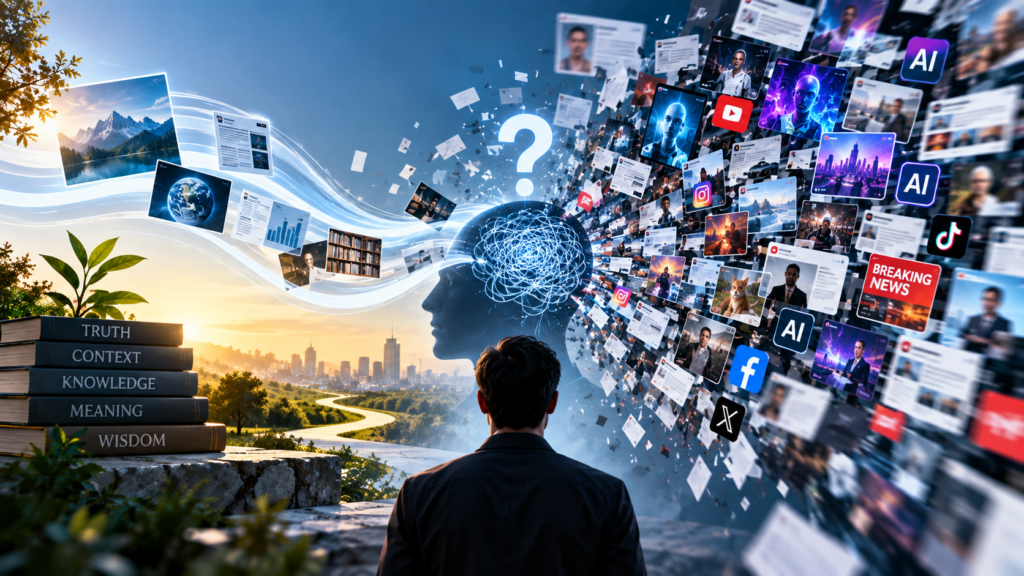
Information Overload Has Created a Crisis of Meaning
The information revolution has created an apparent contradiction.
Humanity has access to more information than at any point in history.
Yet access to information has not necessarily produced greater clarity.
Instead, individuals and organizations increasingly face:
The central problem is therefore changing.
The challenge is no longer simply obtaining information.
It is determining what information can be trusted, what information matters, and what it means.
This is where The Architecture of Information becomes particularly relevant.
Instead of treating information merely as data, the book moves toward frameworks for verification, interpretation, and sense-making.
That distinction is becoming critical in the AI era.
Machines can generate enormous quantities of information.
They can recognize patterns, manipulate symbols, summarize documents, generate text, and automate analysis.
But societies still depend on human institutions to decide what information means and what actions should follow from it.
AI Can Generate Content, but Humans Still Create Meaning
This distinction also has major implications for business.
Artificial intelligence is rapidly reducing the cost of producing content.
Articles, advertisements, images, product descriptions, reports, videos, presentations, and marketing material can now be produced at extraordinary speed.
The result is predictable:
the world is becoming saturated with synthetic content.

When everyone can create more content, simply producing information stops being a competitive advantage.
Meaning becomes the advantage.
Trust becomes the advantage.
Understanding human motivation becomes the advantage.
Books such as Mind Over Market and Why They Buy explore this shift from another direction.
Businesses operating in the information economy cannot rely exclusively on algorithms or automation.
They still need to understand:
Technology may determine how information reaches people.
Human psychology still determines how much of that information matters.
Algorithmic Governance Is Becoming a Political Reality
The Fourth Revolution is also transforming governments.
Modern states increasingly depend on digital infrastructure for administration, taxation, public services, security, identification, communication, economic planning, and policy implementation.
At the same time, algorithms increasingly influence decisions that once belonged entirely to human institutions.
This raises difficult questions about algorithmic governance.
Who designs the systems?
Who owns the data?
Who audits the algorithms?
Who is responsible when automated systems make incorrect decisions?
How should governments regulate technologies they increasingly depend upon?
And perhaps most importantly:
What happens to countries that lack the institutional capacity to build or govern these systems effectively?
Books such as The Capability Trap, The Reordering, and Future of Humanity: 2025–2035 place these questions within the broader challenges facing governments and developing societies.
The Fourth Revolution Looks Different in Developing Economies
This distinction matters enormously.
A significant portion of the global conversation around digital transformation assumes conditions that are common in advanced economies:
strong institutions, reliable infrastructure, mature capital markets, skilled workforces, research ecosystems, large technology companies, and significant public-sector capacity.
But much of the world does not begin from those conditions.
Developing economies must often participate in the information revolution while simultaneously dealing with:
That creates a fundamentally different strategic problem.
A country cannot simply import a Silicon Valley model and expect identical results.
The starting conditions are different.
Books such as The Dollar Mindset and The Capability Trap approach emerging-market constraints as central strategic variables rather than minor exceptions.
This is important because the Fourth Revolution will not affect every society equally.
Countries capable of building digital institutions, technological capabilities, human capital, and information resilience may gain extraordinary advantages.
Those that cannot may become increasingly dependent on systems designed elsewhere.
Information Power Is Also Narrative Power
Technology alone does not determine how societies behave.
Stories matter.
Collective identity matters.
Belief matters.
The interpretation of events matters.
This is where The Narrative Wars introduces another important dimension of the information revolution.
Information conflict is not simply a cybersecurity problem.
It is also a battle over the stories societies tell themselves.
Nations operate through narratives.
Brands operate through narratives.
Political movements operate through narratives.
Organizations build cultures through narratives.
Individuals construct identities through narratives.
Control over information therefore creates the possibility of influencing how people interpret their past, understand their present, and imagine their future.
In the information age, narrative power may become one of the most important forms of strategic power.
Connecting Fields That Are Usually Kept Separate
One of the more interesting characteristics of Dr. Atique Ur Rehman’s body of work is its attempt to connect disciplines that are often studied separately.
These include:
information philosophy, strategic studies, behavioral psychology, economics, governance, technology, branding, narrative, and institutional capability.
That interdisciplinary approach reflects the reality of the Fourth Revolution itself.
Artificial intelligence cannot be understood purely as a computer-science problem.
Information warfare cannot be understood purely as a military problem.
Digital transformation cannot be understood purely as an IT project.
Consumer behavior cannot be understood purely through analytics.
Governance cannot be separated from technology.
And technology cannot be separated from questions of power, identity, psychology, and meaning.
The information age connects these fields whether academic institutions do or not.
Philosophy Still Matters—But It Must Lead Somewhere
None of this diminishes the importance of philosophy.
The work of thinkers such as Luciano Floridi remains essential because societies first need conceptual frameworks capable of explaining what is happening.
Without philosophy, technological change risks being understood only through products, platforms, and short-term trends.
Philosophy asks the deeper questions.
What happens when human identity becomes partly digital?
What responsibilities exist inside the infosphere?
What does autonomy mean when algorithms increasingly influence human decisions?
What happens when information becomes part of the environment in which humanity exists?
These questions matter.
But the Fourth Revolution demands another layer.
It requires a transition from:
understanding to capability,
observation to strategy,
diagnosis to action.
From Information Philosophy to Information Strategy
This may ultimately be the most important challenge of the information age.
The technological systems reshaping society are advancing faster than many institutions can adapt.
Artificial intelligence is evolving.
Information warfare is evolving.
Markets are evolving.
Media ecosystems are evolving.
Algorithms are becoming more influential.
Synthetic content is multiplying.
Governments are attempting to regulate technologies whose capabilities change faster than traditional policy cycles.
The world therefore needs thinkers who can describe these transformations.
But it also needs frameworks that help people operate within them.
That is what the books across Dr. Atique Ur Rehman’s catalogue appear to be attempting: converting theoretical insight into usable strategic maps.
Whether every framework ultimately succeeds is something readers, practitioners, and history will determine.
But the need for such work is difficult to dispute.
The Real Strategic Vulnerability of the Information Age
The greatest vulnerability of the Fourth Revolution may not simply be technological weakness.
It may be the distance between what societies understand and what they are capable of doing.
Knowing that misinformation is dangerous does not create information resilience.
Knowing that AI will transform employment does not create a skilled workforce.
Knowing that algorithms influence public opinion does not create stronger institutions.
Knowing that digital transformation is necessary does not create organizational capability.
And knowing that information has become strategically important does not automatically create an information strategy.
That gap between knowledge and action can itself become a national, institutional, and business vulnerability.
Conclusion: The Fourth Revolution Will Reward Those Who Can Act
The Fourth Revolution is not approaching.
It is already underway.
Information has become infrastructure, economic capital, political influence, competitive advantage, and strategic weaponry.
Artificial intelligence is accelerating that transformation.
Theories of the infosphere help us understand the environment we have entered.
But understanding the environment is only the beginning.
The organizations and societies that succeed will be those capable of converting information into knowledge, knowledge into strategy, and strategy into capability.
This is why the conversation must move beyond describing the information age.
We must learn how to operate inside it.
The Fourth Revolution will not be navigated by those who only describe it. It will be shaped by those who learn how to act within it.
Frequently Asked Questions
What is the Fourth Revolution?
The Fourth Revolution refers to the transformation of human society caused by the growing importance of information, digital technologies, artificial intelligence, algorithms, and interconnected information systems.
What is the infosphere?
The infosphere is a concept associated with information philosophy describing the interconnected informational environment in which humans, digital technologies, organizations, and information systems interact.
What is hyperhistory?
Hyperhistory describes a stage of human development in which societies depend heavily on information and communication technologies for their economic, political, and social functioning.
How is AI connected to the Fourth Revolution?
Artificial intelligence accelerates the Fourth Revolution by automating information processing, content generation, analysis, decision support, personalization, and increasingly complex organizational processes.
Why is information strategy important?
Information strategy helps organizations and governments determine how information should be collected, verified, protected, interpreted, communicated, and transformed into effective decisions.
Why are developing countries especially important in discussions about the Fourth Revolution?
Developing countries often face the information revolution while still addressing infrastructure, institutional capacity, education, financing, and governance challenges. Their strategies therefore cannot simply replicate models created for advanced economies.
What is information warfare?
Information warfare involves the strategic use of information, narratives, digital platforms, psychological influence, cyber capabilities, and communication systems to shape perceptions, decisions, or behavior.
Why does philosophy alone not solve the challenges of the information age?
Philosophy provides the concepts needed to understand technological and informational transformation. Governments, businesses, and societies must then convert those insights into policies, institutions, strategies, technologies, and practical capabilities.