
Table of Contents
AI vulnerability discovery is changing the ai cybersecurity relationship by reducing the time and specialist effort required to inspect large codebases, find suspicious behavior, test security hypotheses, reproduce crashes, develop proof-of-concept exploits and validate patches. Human researchers are still essential, but frontier AI systems are increasingly capable of performing parts of the vulnerability-research process autonomously. The result could be faster defensive discovery, but also shorter windows between a vulnerability becoming known and attackers attempting to exploit it.
For years, artificial intelligence in software development was associated mainly with writing code.
Generate a function.
Explain an error.
Create a test.
Refactor an application.
That picture is becoming outdated.
The same systems that understand code well enough to write it can increasingly inspect code for weaknesses, reason about unexpected states, test whether a flaw matters and help security researchers determine whether a coding bug can become a real cybersecurity threat.
Recent events have made the shift difficult to ignore.
In October 2026, researchers disclosed critical vulnerabilities in PHP that had survived inside one of the web’s most important software runtimes for years. Frontier AI systems helped researchers understand the weaknesses, develop exploitation paths, improve detection and validate patches. (cloud.google.com)
That case, known as PHP2Shell, raises a larger question:
What happens when vulnerability research itself becomes scalable?
What Is AI Vulnerability Discovery?
AI vulnerability discovery is the use of machine-learning models, large language models and autonomous agents to help identify security weaknesses in software.
That can involve much more than searching for obviously dangerous code.
Modern systems can assist researchers with:
- reading large repositories
- tracing data flows
- identifying unsafe assumptions
- generating unusual test cases
- reproducing crashes
- comparing vulnerable and patched code
- analyzing memory corruption
- prioritizing suspicious code
- suggesting patches
- validating whether a fix actually works
Traditional security tools already perform static analysis, fuzzing and automated testing.
AI adds another layer: reasoning across context.
A conventional scanner may recognize a known pattern.
An AI system can increasingly ask:
What if these two pieces of code interact in an unexpected way?
That is a much more difficult problem.
1. AI Can Read More Code Than Human Researchers
One of the simplest advantages is scale.
Modern software projects can contain millions of lines of code spread across:
- old components
- third-party dependencies
- configuration files
- tests
- build scripts
- networking code
- memory-management logic
A human security researcher cannot manually inspect everything with equal attention.
AI systems can analyze far more material and help identify areas that deserve deeper investigation.
That does not mean AI understands every codebase perfectly.
False positives remain a problem.
Models can misunderstand architecture.
They can also miss subtle vulnerabilities.
But they can substantially reduce the amount of code a human must examine manually.
The workflow changes from:
Find the needle yourself
to:
Let AI identify the most suspicious parts of the haystack, then investigate them carefully.
2. AI Makes Old Bugs Worth Investigating Again
The PHP2Shell case is particularly important because the underlying weaknesses were not necessarily brand new.
Wiz researchers said that vulnerable PHP code had existed for more than a decade, but turning those weaknesses into practical exploitation required unusually complex work involving memory behavior, different configurations and multiple bug chains. (wiz.io)
AI changed the economics.
A vulnerability that might previously require months of expert experimentation may become more practical to investigate when a model can:
- propose hypotheses
- analyze failures
- modify tests
- compare versions
- repeat experiments rapidly
This means old software deserves renewed scrutiny.
A coding bug that was considered too difficult to exploit in 2015 may not remain too difficult in 2027.
The code may not have changed.
The research tools did.
3. AI Accelerates Exploit Verification
Finding unsafe code is not the same as proving that it creates a serious cyber risk.
Security researchers usually have to determine:
- Can an external attacker reach the vulnerable code?
- Does the program crash predictably?
- Can the crash become information disclosure?
- Can memory corruption become controlled execution?
- Does the exploit work on different versions?
- Which configurations are actually exposed?
This is often the hardest part of vulnerability research.
Google said Gemini 4 Argon contributed not only to finding the PHP vulnerabilities but also to exploit development, attack detection and validation of the patch. (cloud.google.com)
That is a significant shift.
AI is moving from:
“This code looks suspicious.”
toward:
“Here is why it is dangerous, how the failure occurs and whether the proposed fix actually prevents it.”
4. Security Agents Can Work for Longer Without Constant Supervision
The next step is agentic security research.
Instead of answering a single prompt, an agent can perform a sequence of tasks:
- inspect a repository
- identify suspicious code
- construct a test
- run the program
- analyze the result
- modify the test
- repeat
- produce a report
OpenAI’s Codex Security, originally introduced as Aardvark, was designed around this idea: an AI security researcher capable of discovering and helping remediate vulnerabilities at scale. (openai.com)
Google has similarly released a cybersecurity-oriented version of Gemini 4 Argon designed for tasks including vulnerability discovery, reverse engineering, exploit verification and patch generation. (cloud.google.com)
The important change is not simply better answers.
It is longer autonomous workflows.
5. AI Can Help Validate Security Patches
Finding vulnerabilities creates another problem.
Someone has to fix them.
And a bad patch can be almost as dangerous as no patch at all.
A fix may:
- block one exploit path
- introduce another bug
- break compatibility
- leave related variants untouched
AI can help researchers examine whether a proposed change actually eliminates the underlying weakness.
This matters particularly for large open-source projects where maintainers have limited time.
The PHP2Shell response involved researchers, PHP maintainers and security vendors working together to test patches and deploy protections before public disclosure. OpenAI described the process as a coordinated effort involving discovery, remediation and defensive preparation. (openai.com)
AI therefore has value on both sides of vulnerability management:
find the bug
and
verify the fix.
6. Defenders May Discover More Zero-Days Before Attackers
This is the optimistic scenario.
For decades, software vulnerabilities often remained hidden until either:
- a researcher discovered them
- an attacker exploited them
- a crash exposed them accidentally
AI could allow defenders to continuously audit important software before an adversary discovers the flaw.
OpenAI has described this as creating a defender’s window, where frontier models find vulnerabilities early enough for maintainers to patch them before attackers gain access to the details. (openai.com)
If that becomes routine, AI could improve security dramatically.
Imagine critical open-source projects being continuously reviewed by autonomous agents looking for:
- memory corruption
- authentication bypasses
- injection flaws
- unsafe deserialization
- privilege-escalation paths
The defensive potential is enormous.
7. Attackers Benefit From the Same Capability
The problem is symmetry.
AI systems do not only help defenders understand software.
They can also help attackers understand:
- security patches
- public advisories
- newly disclosed CVEs
- failed exploit attempts
- server behavior
- configuration differences
Once a vulnerability becomes public, attackers may use AI to convert technical information into working attack attempts faster.
OpenAI has explicitly warned that increasingly capable cyber models could help attackers identify vulnerabilities and develop offensive tools more quickly. (openai.com)
This could compress the traditional patch window.
An organization that once had several days to react may eventually have hours.
That makes patch management, asset inventory and continuous monitoring more important.
8. Vulnerability Management Will Become Continuous
Traditional vulnerability management often works in cycles.
Scan.
Review.
Patch.
Repeat next month.
That model may become too slow.
NIST said in 2026 that AI and the increasing volume of reported vulnerabilities are creating pressure to move from periodic remediation toward continuous, automated and contextual vulnerability management. (nist.gov)
The future workflow may look more like:
Continuous code analysis → AI-assisted vulnerability discovery → automatic severity assessment → human verification → patch generation → automated testing → rapid deployment → continuous monitoring
9. Human Security Researchers Still Matter
AI vulnerability discovery does not make human experts obsolete.
In fact, more powerful AI may increase the value of experienced researchers.
Humans still provide:
- target selection
- architectural understanding
- threat modeling
- ethical judgment
- responsible disclosure
- context
- prioritization
- validation
AI can generate thousands of hypotheses.
Someone still has to determine which ones matter.
The PHP2Shell discovery process illustrates this clearly. Human researchers knew where to look, recognized the significance of the results, tested the findings and coordinated disclosure with maintainers.
The better model is therefore:
AI for scale, humans for judgment.
What Does This Mean for Software Developers?
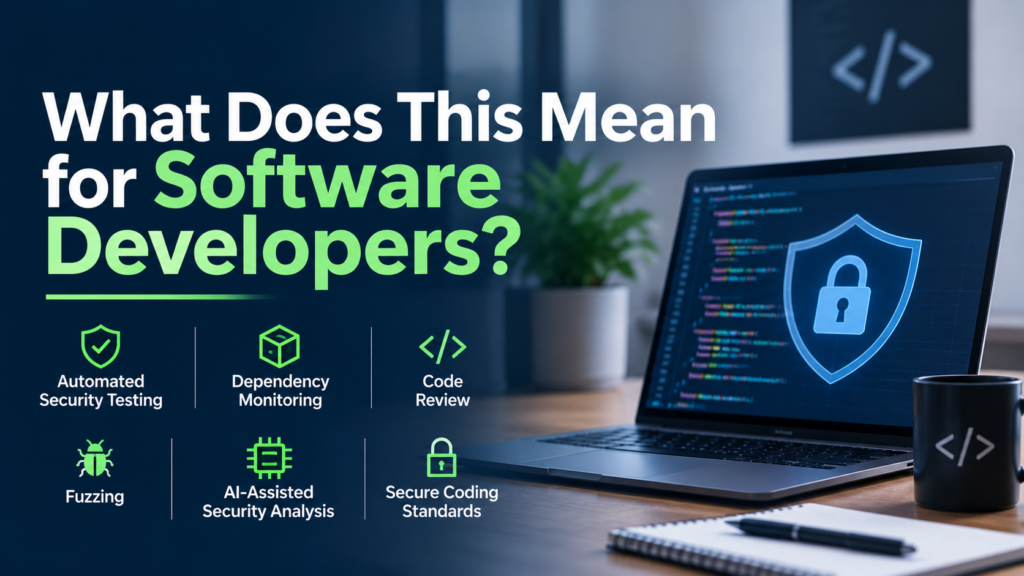
Developers should assume that insecure assumptions will become easier to find.
That means security should move earlier into development.
Teams should increasingly use:
- automated security testing
- dependency monitoring
- code review
- fuzzing
- AI-assisted security analysis
- secure coding standards
The goal is not to wait for an external researcher to discover a critical coding bug.
It is to find the flaw before production.
What Does AI Vulnerability Discovery Mean for Cyber Risk?
The biggest change is speed.
AI compresses the lifecycle of a vulnerability.
What previously looked like:
bug exists for years → researcher discovers it → exploit appears later → organizations patch
may increasingly become:
AI finds bug → exploitability is tested → disclosure occurs → attack attempts appear rapidly
That changes the definition of operational readiness.
Organizations need to know:
- what software they run
- which versions are exposed
- which systems face the internet
- who owns patching responsibility
- how quickly emergency changes can be deployed
An organization cannot patch quickly if it does not know what it owns.
How to Prepare Your Business for AI Vulnerability Discovery
You do not need a large security team to benefit from AI vulnerability discovery. What you need is a clear process for finding, ranking and fixing problems faster than before. The steps below work for small businesses, agencies and software teams alike.
Know What Software You Actually Run
AI vulnerability discovery is only useful when you know which systems to protect. Start with a simple inventory of your website platform, plugins, themes, cloud services and any custom code. Outdated components that nobody remembers installing are often the easiest targets for attackers.
Shorten Your Patch Cycle
As AI vulnerability discovery speeds up, the time between a public disclosure and a working exploit gets shorter. Set a target for applying critical security updates, such as within 48 hours, and assign a named person to make sure it happens. Turn on automatic updates where it is safe to do so.
Use AI Tools on Your Own Code First
If your team writes code, try AI-assisted code review and scanning tools before release rather than after an incident. Treat their findings as leads, not final answers. A developer should confirm each issue, check whether it can really be exploited and record the fix.
Plan for Responsible Disclosure
More researchers now use AI vulnerability discovery, so the chance that someone reports a flaw in your product is higher. Publish a simple security contact page or a security.txt file so researchers know how to reach you, and decide in advance who will respond and how quickly.
Businesses that prepare now will treat AI vulnerability discovery as an advantage. Businesses that wait will find that attackers using the same tools have reached their weaknesses first.
The Bottom Line
AI is not creating the fundamental idea of vulnerability research and AI vulnerability discovery.
Security researchers have been auditing code, fuzzing software and developing exploits for decades.
What AI changes is the cost and speed of the work.
Large codebases become easier to inspect.
Complex hypotheses become cheaper to test.
Failed exploit attempts can be analyzed and revised more rapidly.
Patches can be reviewed faster.
And autonomous agents can perform parts of the research process without a human directing every individual step.
That creates one of the biggest opportunities in modern cybersecurity.
Defenders may finally be able to uncover weaknesses that have survived years of human review.
But the same technology also creates a new cybersecurity threat.
Complexity is no longer as strong a shield.
A vulnerability does not become harmless simply because exploitation once required rare expertise.
AI can make difficult work cheaper.
That may be the defining shift.
The future of vulnerability discovery will not be a contest between humans and machines.
It will increasingly be a contest between human teams using machines well and adversaries doing the same.
The side that finds, verifies and fixes the vulnerability first will have the advantage.
Frequently Asked Questions
What is AI vulnerability discovery?
AI vulnerability discovery is the use of AI models and autonomous agents to analyze software, identify potential security flaws, test whether they are exploitable and help developers remediate them.
Can AI find zero-day vulnerabilities?
Yes. Frontier AI systems have demonstrated the ability to identify previously unknown security flaws under research conditions. Some current cybersecurity models are specifically designed for vulnerability discovery and exploit verification. (openai.com)
Will AI replace cybersecurity researchers?
Not currently. AI can automate and accelerate many tasks, but experienced researchers remain essential for context, prioritization, validation and responsible disclosure.
Can hackers use AI to find vulnerabilities?
Yes. The same reasoning and coding capabilities useful for defensive research can potentially help attackers analyze code, understand vulnerabilities and adapt exploit attempts.
Why was PHP2Shell important for AI security research?
PHP2Shell demonstrated that AI-assisted researchers could help turn complex, longstanding weaknesses in widely used software into practical vulnerability findings and validated exploit paths. (wiz.io)
Is AI vulnerability discovery good or bad for cybersecurity?
It can be both. AI gives defenders unprecedented ability to find and fix vulnerabilities, but attackers can benefit from similar capabilities. The outcome depends heavily on who discovers a flaw first and how quickly defenders can patch it.
How can a small business use AI vulnerability discovery?
Start by keeping all software up to date, then use AI-assisted scanning tools or a managed security provider to check your website and custom code. Ask a qualified person to confirm each finding before acting on it.
How often should AI vulnerability discovery scans run?
For most businesses, an automated scan every week and after every major update is a sensible baseline. Teams that release code daily should run AI vulnerability discovery checks as part of every build.