
Table of Contents
Quick answer: The major PHP vulnerability disclosed in October 2026 is a pair of critical flaws known collectively as the PHP2Shell vulnerability. Tracked as CVE-2026-109618 and CVE-2026-109619, the bugs affect PHP’s core request-handling logic and can, under vulnerable conditions, lead to unauthenticated remote code execution. The PHP project released fixes in PHP 8.5.12, 8.4.27, 8.3.36 and 8.2.35 on October 21. The deeper story is that AI-assisted security research helped researchers understand and weaponize a class of coding bug that had survived for years, showing how artificial intelligence may permanently change the economics of vulnerability discovery.
A PHP vulnerability is not unusual by itself.
Software used for decades will inevitably accumulate bugs.
What makes PHP2Shell different is the scale of the technology involved, the seriousness of the potential impact, and the role artificial intelligence played in turning obscure memory-safety problems into practical security research.
PHP sits beneath WordPress, Drupal, Joomla, MediaWiki, Laravel, Symfony and countless custom web applications.
So when the problem exists inside PHP itself rather than in a plugin or individual application, the potential cyber risk becomes much broader.
The PHP project issued an unusually direct warning on October 21: all PHP installations serving web requests should update immediately, and there is no complete mitigation that makes remaining on a vulnerable release equally safe.
This is therefore more than another php bug.
It is a case study in what happens when old software meets a new generation of AI-powered vulnerability research.
PHP Vulnerability 2026: What Is PHP2Shell?
PHP2Shell is the informal name used for two critical PHP flaws:
- CVE-2026-109618
- CVE-2026-109619
Both received a CVSS 4.0 score of 9.2, placing them in the critical severity category.
The official PHP advisory says affected web-serving environments include:
- PHP-FPM
- Apache with mod_php
- php-cgi
- FrankenPHP
- LiteSpeed
The PHP team considers the risk especially serious for mod_php, where researchers demonstrated that an unauthenticated request could trigger the vulnerable path before normal application code runs.
That distinction matters.
The PHP2Shell vulnerability is not fundamentally a WordPress flaw, Drupal flaw or Joomla flaw.
The vulnerable behavior exists beneath those applications in PHP itself.
That means an application can be fully updated while the underlying runtime remains exposed.
PHP2Shell at a Glance
| Item | Current information |
|---|---|
| Name | PHP2Shell |
| Core CVEs | CVE-2026-109618, CVE-2026-109619 |
| Severity | Critical, CVSS 9.2 |
| Main risk | Unauthenticated remote code execution |
| Other possible impact | Memory disclosure, crashes, denial of service |
| Disclosure date | October 21, 2026 |
| Affected technology | PHP core runtime |
| Highest demonstrated risk | Apache mod_php |
| Fixed versions | PHP 8.5.12, 8.4.27, 8.3.36, 8.2.35 |
| Main defense | Upgrade PHP |
| AI role | Discovery, analysis, exploit development, detection and patch validation |
The official PHP release notes are the best source for patch status and affected runtime guidance. Official PHP security advisory
What Exactly Is the PHP Bug?
The two flaws belong to the broad family of memory-safety errors.
Memory errors can occur when software creates, modifies or destroys internal data incorrectly.
They are particularly dangerous because the program may continue operating while referring to memory that is incomplete, invalid or already released.
CVE-2026-109618: Out-of-Memory Corruption
PHP uses an internal mechanism to abort a request when memory runs out.
The PHP vulnerability tracked as CVE-2026-109618 occurs because certain operations can be interrupted while internal request data is only partly initialized.
Later cleanup code may then process that invalid state as if it were legitimate.
The official CVE record describes the result as a condition that can lead to remote code execution.
In simple terms:
- PHP starts building internal data.
- Memory exhaustion interrupts the process.
- Some state remains incomplete.
- Cleanup logic later encounters that state.
- Under carefully controlled conditions, the resulting corruption may be exploitable.
That is the kind of coding bug developers fear because the dangerous behavior may happen far away from the original failure.
CVE-2026-109619: Stale Internal State
The second php bug involves internal state that can survive longer than the memory backing it.
A later request handled by the same PHP worker may encounter stale information before normal initialization resets it.
The official PHP advisory describes this as request-owned internal state surviving after its backing memory has been freed.
This type of error belongs to the broader class of use-after-free and stale-pointer problems.
For a non-technical analogy, imagine a building access card remaining active after the office it belonged to has been reassigned.
The system still trusts a reference that should no longer be trusted.
In software, that mistake can expose memory or alter program behavior.
Why Remote Code Execution Is Such a Serious Cybersecurity Threat
Remote code execution, usually shortened to RCE, means an attacker may be able to force a target system to execute instructions remotely.
That is one of the most serious outcomes in web security.
If an attacker obtains code execution inside a PHP worker, the exact consequences depend on server permissions and isolation, but potential risks include:
- reading application secrets
- accessing database credentials
- stealing API keys
- modifying website files
- planting malicious code
- creating persistence
- redirecting visitors
- attacking connected infrastructure
- using the server in additional campaigns
This does not mean every vulnerable PHP website automatically gives an attacker full root-level control.
Real exploitation depends on environment, process layout, configuration and operating-system defenses.
But unauthenticated RCE is serious enough that the UK’s National Cyber Security Centre urged organizations to take immediate action.
How Was the PHP2Shell Vulnerability Discovered?
The discovery involved several independent security teams rather than one single automated system.
Calif Research says it began exploring PHP’s historical memory-limit behavior and discovered multiple paths leading toward remote code execution in August 2026.
Its timeline says the first issue was reported to the PHP project on August 11, a working RCE proof of concept was shared on August 14, and PHP confirmed the behavior on August 15.
Wiz Research independently began investigating PHP during the same period.
Wiz says its researchers used a combination of:
- Wiz Atlas
- Google Gemini 4 Argon
- OpenAI GPT-5.6 Sol
- human security expertise
Wiz reported its first vulnerability discovery on August 19, confirmed unauthenticated RCE against Drupal on August 20 and against WordPress on August 21, then reported the flaws to PHP on August 24.
Google Cloud later confirmed that Gemini 4 Argon contributed to vulnerability discovery, exploit development, attack detection and validation of the patch.
This makes PHP2Shell one of the clearest recent examples of AI vulnerability discovery moving from theory into real-world software security.
Did AI Discover the PHP Vulnerability by Itself?
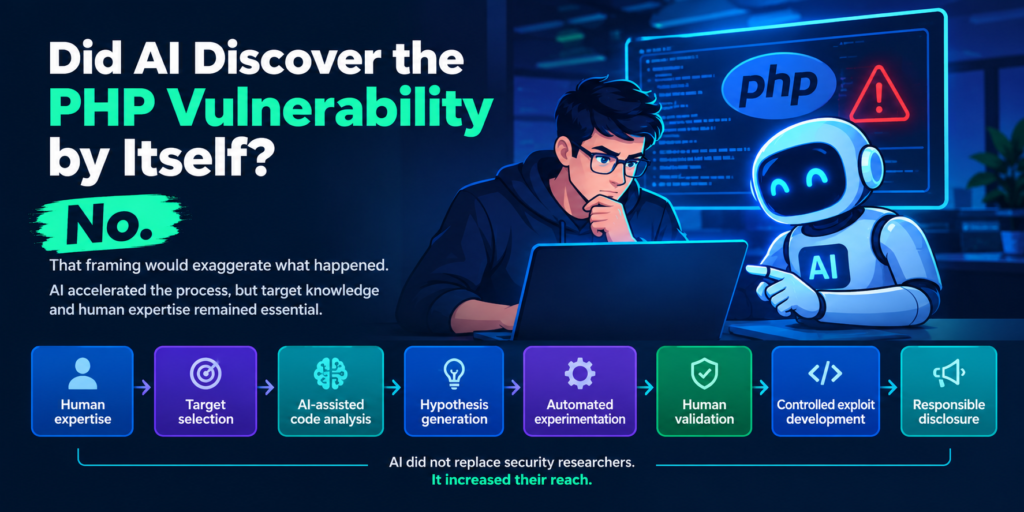
No.
That framing would exaggerate what happened.
Calif’s own account explicitly says target knowledge and human expertise remained essential.
Researchers already understood PHP’s history, knew what kinds of memory-limit behavior were worth investigating and formed hypotheses about where old weaknesses might remain.
That distinction matters.
The workflow looked more like:
- Human Expertise
- Target Selection
- AI-Assisted Code Analysis
- Hypothesis Generation
- Automated Experimentation
- Human Validation
- Controlled Exploit Development
- Responsible Disclosure
AI did not replace security researchers.
It increased their reach.
How Did AI Help Find the Coding Bug?
Traditional vulnerability research can require enormous amounts of repetitive reasoning.
A researcher may need to inspect interactions between:
- request parsers
- memory allocation
- error handling
- sessions
- process workers
- cleanup functions
- server interfaces
- shared state
A flaw may occur in one function while the exploitable result appears several layers later.
AI models can help researchers explore these possibilities faster.
According to Google and Wiz, the systems involved were used for tasks including vulnerability analysis, exploit-development assistance, detection engineering and patch validation.
The important change is economic.
A difficult coding bug that previously required weeks or months of manual experimentation may become practical to investigate when an AI agent can rapidly:
- read large codebases
- compare code paths
- propose hypotheses
- generate test cases
- analyze crashes
- revise failed approaches
- inspect patches
- repeat experiments
This does not make every software bug instantly exploitable.
It does make complexity less protective than it used to be.
How Old Is the PHP Vulnerability?
The answer requires careful wording.
The current PHP2Shell CVEs were disclosed in 2026, but researchers say the vulnerable design patterns extend much further back.
Wiz says PHP versions going back to 5.4 were affected by at least one of the disclosed issues and that vulnerable code had survived for more than a decade.
Calif traces the broader history of PHP memory-limit exploitation research back to 2004, when related memory-safety behavior was investigated by PHP security researcher Stefan Esser.
That does not mean CVE-2026-109618 is literally one untouched 2004 bug.
It means PHP has a long history of difficult interruption and memory-state problems, and some of the modern PHP2Shell paths descend from that broader class of weaknesses.
Why Did the PHP Bug Survive for So Long?
This is one of the most important lessons.
A vulnerability can be real without being practically exploitable.
Security researchers may discover unsafe behavior and still be unable to turn it into stable remote code execution.
The challenge increases when exploitation depends on:
- process memory layout
- server configuration
- request sequencing
- memory exhaustion
- reuse of worker processes
- operating-system protections
Before AI-assisted research, the cost of exploring thousands of combinations could exceed the likely value of the result.
AI changed that calculation.
A bug that was previously considered too difficult, unpredictable or time-consuming to weaponize may become worth revisiting.
That creates a new cyber risk for old software.
Historical code does not become safer simply because nobody exploited it yesterday.
Which Websites Are Affected?
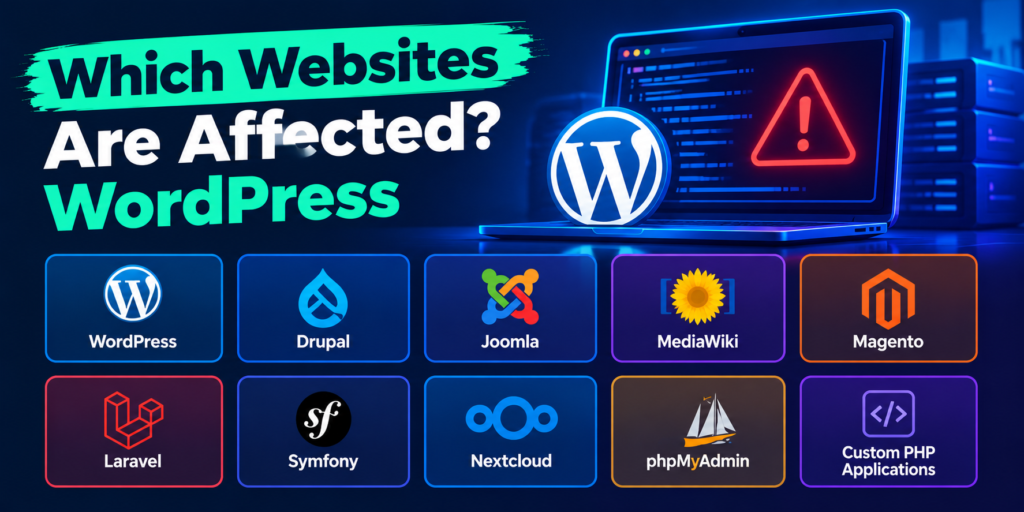
The risk exists wherever vulnerable PHP releases serve web requests.
That includes applications built with or running beneath:
- WordPress
- Drupal
- Joomla
- MediaWiki
- Magento
- Laravel
- Symfony
- Nextcloud
- phpMyAdmin
- custom PHP applications
Wiz demonstrated the PHP2Shell vulnerability in controlled testing against several popular PHP applications, but stressed that the flaw exists in PHP itself rather than those applications.
Google similarly warns that updating a Drupal module or application package does not fix the underlying runtime flaw. PHP itself must be updated.
This is an important web application security lesson.
A secure application can still inherit a serious cybersecurity threat from the runtime beneath it.
Which PHP Versions Are Patched?
PHP released the following fixed versions:
| PHP branch | Patched release |
|---|---|
| PHP 8.5 | 8.5.12 |
| PHP 8.4 | 8.4.27 |
| PHP 8.3 | 8.3.36 |
| PHP 8.2 | 8.2.35 |
PHP recommends updating immediately.
Older unsupported branches require additional attention because the main PHP project is not issuing new official fixes for PHP 8.1 and earlier. Vendor-supported backports may exist in some distributions or hosting products, but organizations should verify those patches with their vendor rather than assuming an old version is safe.
Plesk, for example, published its own patched builds for some legacy PHP branches.
Does Updating WordPress Fix the PHP Vulnerability?
No.
This deserves emphasis because many website owners manage WordPress but never directly manage PHP.
Updating:
- WordPress core
- plugins
- themes
- WooCommerce
- page builders
does not automatically patch the PHP runtime.
The PHP vulnerability exists underneath the CMS.
The hosting server or container must run a patched PHP package.
For managed hosting, the provider may have handled this centrally.
For self-managed VPS, cloud servers or dedicated systems, the administrator is responsible for verifying the runtime.
Was PHP2Shell Exploited Before Public Disclosure?
AWS Threat Intelligence found suspicious PHP2Shell exploitation activity dated October 17, four days before the coordinated public disclosure.
The attempt targeted an AWS MadPot honeypot and came through a commercial anonymization network.
AWS said it could not determine how the actor obtained information about the vulnerability while the issue was still under embargo.
AWS Threat Intelligence PHP2Shell analysis
That is significant because coordinated disclosure normally attempts to give maintainers and defenders time to patch before attackers obtain technical details.
PHP2Shell shows how fragile that window can be.
Is PHP2Shell Being Exploited in the Wild?
The answer is more nuanced than some headlines suggest.
AWS observed exploitation attempts before disclosure.
The Canadian Centre for Cyber Security later reported open-source evidence of exploitation and noted that CISA added both original PHP2Shell CVEs to its Known Exploited Vulnerabilities catalog on October 26.
However, Wiz’s October 27 telemetry update said it had seen only a limited number of attempts and had not observed successful generalized end-to-end PHP2Shell exploitation in its own telemetry.
Wiz did acknowledge stronger public evidence from honeypot research showing code execution under a favorable Apache mod_php configuration.
The safest conclusion is therefore:
real exploitation activity exists, but the reliability and scale of successful compromise vary by environment and remain less universal than the most dramatic headlines imply.
That distinction matters for accurate cybersecurity reporting.
Why a Firewall Does Not Completely Solve the Problem
Cloudflare deployed protections against known PHP2Shell attack patterns.
That is useful defense in depth.
But Cloudflare also stresses that application-layer protections do not remove the vulnerable PHP code itself.
Cloudflare PHP2Shell protection guidance
Attack patterns evolve.
Configurations differ.
A web application firewall may block known requests but cannot guarantee protection against every future technique.
The core PHP project therefore gives simpler advice:
update.
A Related PHP Vulnerability Appeared Two Days Later
The story did not end on October 21.
On October 23, PHP published an informational advisory for a separate issue, CVE-2026-115560, involving session upload progress and unusual serializer configuration.
This vulnerability is not the same as the original two PHP2Shell CVEs.
PHP says exploitation requires an uncommon combination of configuration and application behavior.
Until the next regular bug-fix release, PHP recommends disabling session.upload_progress.enabled for environments that require full protection from this additional path.
This follow-up reinforces an important lesson:
patching the original PHP2Shell vulnerability does not mean administrators should stop monitoring PHP security advisories.
Why PHP2Shell Is a Web Application Security Problem
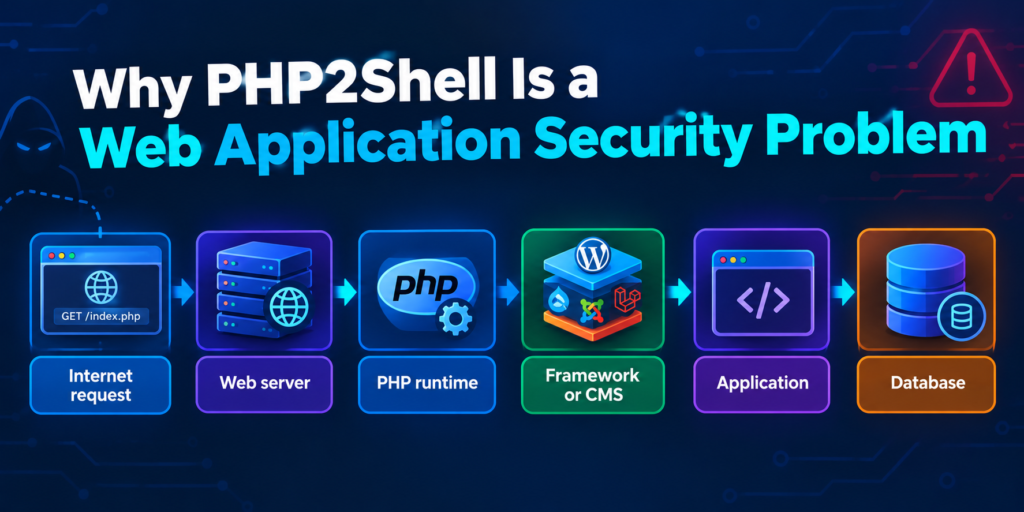
Web security is layered.
A typical web stack looks roughly like this:
- Internet request
- Web server
- PHP runtime
- Framework or CMS
- Application
- Database
Security has to work across every layer.
Organizations often focus heavily on:
- application passwords
- plugin updates
- authentication
- input validation
- CMS security
Those are important.
But PHP2Shell demonstrates that application security also depends on the language runtime.
A perfectly written application cannot compensate for every serious flaw beneath it.
That is why modern web application security requires software inventory and runtime visibility, not only code review.
What Website Owners Should Do About the PHP Vulnerability
The response should be practical rather than dramatic.
1. Identify the actual PHP version
Do not infer the version from WordPress or another CMS.
Check the server or hosting environment.
2. Upgrade to a patched release
Use PHP 8.5.12, 8.4.27, 8.3.36 or 8.2.35, or an explicitly patched vendor build.
3. Restart long-running workers
An updated package does not help if vulnerable processes remain running.
Restart PHP-FPM, Apache or other relevant workers according to your environment.
4. Keep WAF protection enabled
A firewall adds another barrier against known exploitation attempts.
5. Review server and application logs
Look for anomalous requests, unexpected process behavior, file changes and other indicators of compromise around the disclosure period.
6. Assess previously exposed systems
If an internet-facing server remained vulnerable during active scanning, do not assume patching proves it was never compromised.
Patch first, then investigate based on your organization’s cyber risk.
What PHP2Shell Means for AI and Cybersecurity
The most important lesson may have nothing to do with PHP.
For years, software security benefited from an accidental barrier:
some bugs were too difficult to understand or weaponize economically.
AI weakens that barrier.
A security researcher can now combine deep expertise with models capable of rapidly reading code, generating experiments and evaluating failures.
Attackers can use similar tools once technical details become available.
AWS explicitly warned that AI-assisted analysis is reducing the time required to transform patches and advisories into exploit attempts.
That creates a new cybersecurity environment.
Vulnerability discovery gets faster
Defenders can inspect mature software more deeply.
Exploit development may accelerate
The time between disclosure and attack can shrink.
Old coding bugs become new cyber risks
A decades-old coding bug may become dangerous when AI reduces the expertise or time needed to understand it.
Patch management becomes more urgent
Organizations may have less time to react after a critical advisory.
Open-source security becomes strategic infrastructure
Widely used runtimes such as PHP need sustained investment because their security affects enormous numbers of organizations.
The Bigger Story: AI Changed the Economics of the PHP Bug
The PHP vulnerability will eventually disappear from the daily news cycle.
Servers will be updated.
Hosting companies will deploy fixes.
Security products will learn the attack patterns.
But PHP2Shell leaves behind a much more important question.
How many old coding bugs exist today only because they have historically been too difficult to turn into practical attacks?
PHP2Shell suggests that answer may matter more than we previously thought.
AI did not create the vulnerable code.
It did not remove the need for experienced researchers.
It did something subtler.
It reduced the cost of exploring complexity.
That is good news for defenders because software that survived years of traditional auditing can now receive another level of scrutiny.
It is also a new cyber risk because attackers benefit from many of the same advances.
The future of cybersecurity may therefore depend less on whether AI can discover vulnerabilities and more on which side can discover, verify, patch and deploy faster.
That is what makes the PHP2Shell vulnerability more than another PHP security incident.
It is a warning about an approaching era in which yesterday’s difficult php bug can become tomorrow’s urgent cybersecurity threat, not because the underlying code changed, but because the tools used to understand it did.
Frequently Asked Questions About the Recent PHP Vulnerability
What is the PHP issue?
The major recent PHP vulnerability is a pair of critical bugs called PHP2Shell, tracked as CVE-2026-109618 and CVE-2026-109619. They can cause memory corruption and, under vulnerable conditions, unauthenticated remote code execution.
What is a PHP exploit?
A PHP exploit is a method that takes advantage of a flaw in PHP or PHP-based software. Depending on the vulnerability, the result may include a crash, information disclosure, authentication bypass or remote code execution.
What should I do about the PHP vulnerability?
Update PHP to a fixed release, restart affected workers, retain WAF protections and review exposed systems for suspicious activity. Updating WordPress alone does not patch PHP2Shell.
What is the recent PHP vulnerability?
The most prominent recent PHP security issue is the PHP2Shell vulnerability, disclosed on October 21, 2026. A separate PHP issue, CVE-2026-115560, was disclosed on October 23 and requires different conditions.
Is the PHP bug a WordPress vulnerability?
No. WordPress can run on vulnerable PHP, but the original PHP2Shell flaws are in PHP itself.
How did AI find the coding bug?
Human researchers used AI systems to accelerate source-code analysis, hypothesis testing, exploit research, detection development and patch validation. The discovery still required specialist human knowledge and responsible disclosure.
Is PHP2Shell an active cybersecurity threat?
Yes, it represents a serious cybersecurity threat because exploitation activity has been reported and the CVEs have been added to government vulnerability tracking. However, successful exploitation is configuration-sensitive and not every observed attempt succeeds.
One Response