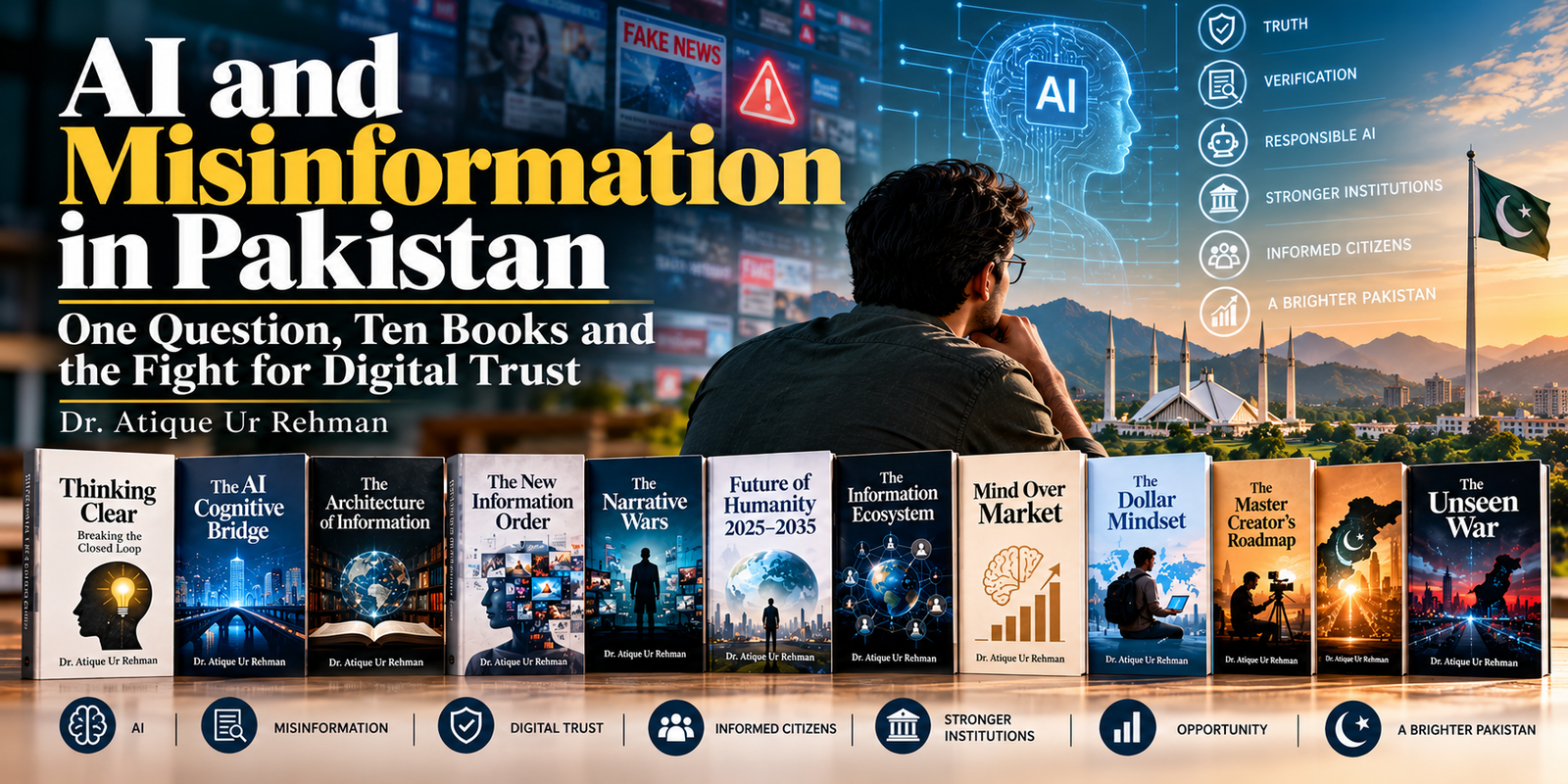
AI and Misinformation in Pakistan: One Question, Ten Books and the Fight for Digital Trust

By Dr. Atique Ur Rehman
Quick answer: Pakistan’s digital challenge is no longer simply access to information. It is deciding what information deserves to be trusted. Artificial intelligence, social platforms, algorithmic recommendations and synthetic media are changing how citizens, institutions and businesses understand reality. Across ten books, I have explored this problem from governance, psychology, information architecture, AI, marketing and individual opportunity. Together, they form one framework for building digital trust in Pakistan.
Pakistan is becoming more connected, more automated and more dependent on digital information.
That creates enormous opportunity.
It also creates a new vulnerability.
When information moves faster than verification, a society can have more content than ever before while becoming less certain about what is true.
This is where artificial intelligence changes the problem.
AI can help governments identify patterns, businesses understand customers and young people reach global markets.
But the same technology can also increase the speed and scale of misleading content, synthetic media and information overload.
The central question is therefore not simply:
How should Pakistan adopt AI?
It is:
How can Pakistan adopt AI without losing control of trust, credibility and human judgment?
That question connects all ten of my books.
1. Thinking Clear: Digital Problems Often Begin Before Technology
My book Thinking Clear begins with the idea that technology does not automatically repair weak thinking.
A sophisticated tool used inside a weak decision system can simply produce weak decisions faster.
The book identifies five habits that can reinforce dysfunction:
- extracting instead of building
- prioritizing the immediate over the long term
- depending on patronage rather than merit
- surrendering agency to fate
- normalizing dysfunction
I describe the interaction between these tendencies as the Closed Loop.
Weak assumptions produce weak decisions.
Weak decisions create poor outcomes.
Poor outcomes reinforce fatalism.
Fatalism then strengthens the same assumptions that created the problem.
The lesson for AI is important.
Before asking what technology can automate, organizations should ask:
What decision process are we automating?
If the underlying process is biased, opaque or badly designed, AI may scale the weakness rather than remove it.
2. The AI Cognitive Bridge: Using AI to Reduce Information Loss
Governments rarely suffer from a complete absence of information.
They often suffer from information that becomes distorted as it moves upward.
A citizen experiences a problem.
A local office records it.
A department summarizes it.
A ministry receives a report.
A senior official sees a dashboard.
At every stage, reality can be compressed.
In The AI Cognitive Bridge, I propose using AI to identify recurring patterns in public-service data, complaints and field reports.
The objective is not surveillance.
It is institutional listening at scale.
AI could help leaders see which complaints are recurring, where services are failing and whether official summaries match citizen experience.
But this model requires boundaries.
It should include:
- no unnecessary surveillance of individuals
- clear legal authority
- transparent models
- independent oversight
- secure domestic data infrastructure
- auditable decision processes
Pakistan has already moved toward formal AI policy. The country approved a National AI Policy in 2025, creating an official framework for AI development and governance.
The next challenge is implementation.
3. The Architecture of Information: Why More Data Does Not Mean More Knowledge
Digital platforms have made information abundant.
Knowledge is still scarce.
That distinction is central to The Architecture of Information.
Information becomes useful knowledge only when people have confidence in how it was produced, verified and interpreted.
Modern societies rely on institutions to perform that function.
Journalists verify claims.
Courts authenticate evidence.
Scientists test hypotheses.
Statistical agencies establish measurement standards.
Auditors check records.
When these institutions lose credibility, citizens are forced to make decisions in an environment where almost every claim becomes contestable.
That is especially dangerous in an AI era.
A synthetic image can appear authentic.
A fake audio clip can imitate a real voice.
A fabricated screenshot can travel across thousands of phones before any institution has time to respond.
The problem is not only false information.
It is the growing difficulty of knowing what deserves belief.
4. The New Information Order: Algorithms Are Now Gatekeepers
For much of history, information gatekeepers were visible.
Editors selected stories.
Teachers selected books.
Broadcasters chose programs.
Today, much of that selection happens through algorithms.
A user opens a platform and receives a personalized stream of content.
The system decides what appears next.
But the optimization goal is not necessarily truth.
It may be engagement.
That distinction matters.
Content that provokes anger, fear or surprise can outperform information that is accurate but less emotionally stimulating.
This creates what I describe as information obesity.
People consume more content than they have the time to verify.
The result can be a strange paradox:
more information, less understanding.
5. The Narrative Wars: Digital Influence Has Real Consequences
My novel The Narrative Wars explores what happens when information conflict moves from screens into ordinary life.
Narratives influence:
- reputations
- elections
- consumer behavior
- public trust
- institutional legitimacy
- national security
The battle is therefore not only over facts.
It is also over interpretation.
A true event can be framed misleadingly.
A false claim can be repeated until it feels familiar.
An authentic video can be dismissed as fake.
The information environment becomes a battlefield in which credibility itself becomes strategic.
6. The Liar’s Dividend: When Truth Can Be Dismissed as Fake
One of the most dangerous consequences of synthetic media is the Liar’s Dividend.
This is an established concept in deepfake scholarship.
The idea is simple.
Once people know that realistic fake videos and audio can be created, someone caught by genuine evidence can claim the evidence was fabricated.
The existence of fake content therefore creates protection for real wrongdoing.
This changes the problem from:
Can people identify a fake?
to:
Can people still establish authenticity at all?
That is why digital trust infrastructure matters.
Provenance systems, verification processes and credible institutions will become more valuable as synthetic media becomes cheaper.
7. Future of Humanity 2025–2035: The Rules Are Being Written Now
Future of Humanity 2025–2035 places the argument on a timeline.
My central thesis is that the current decade is unusually important because AI systems are rapidly becoming embedded inside institutions, businesses and everyday life.
The choices made now will influence:
- what data AI systems can access
- who controls them
- how automated decisions are audited
- how citizens challenge harmful outcomes
- how synthetic media is authenticated
- how businesses use customer information
The point is not that governance becomes impossible after 2030.
The point is that changing embedded systems becomes increasingly expensive and difficult.
It is easier to establish good architecture before dependency becomes permanent.
8. The Information Ecosystem: Trust Is a Business Asset
The same problem affects companies.
A business can no longer assume that producing more content will automatically produce more trust.
Synthetic content has made production cheap.
Credibility is becoming scarce.
The Information Ecosystem argues that companies should treat trust as an accumulated asset.
The rule is simple:
In a crisis, you can spend only the credibility you earned before it.
That matters for marketing.
A brand that repeatedly exaggerates claims cannot suddenly demand trust when a controversy occurs.
Credibility comes from consistency.
That includes:
- evidence
- transparent communication
- accurate claims
- identifiable authorship
- reliable customer experience
- rapid correction of mistakes
This is also why digital marketing is increasingly connected to information architecture.
Search engines and AI systems are trying to identify which sources are worth trusting.
Businesses should therefore build information that is easy to verify.
9. Mind Over Market: More Content Is Not Better Marketing
Mind Over Market applies the same argument to customers.
Modern companies are often encouraged to publish constantly.
More reels.
More posts.
More ads.
More emails.
More AI-generated articles.
But customers do not buy because a company produces the most content.
They buy because the message connects with a problem they actually have.
This is why marketing still depends on:
- psychology
- positioning
- trust
- relevance
- story
- proof
AI can increase production speed.
It cannot decide why a customer should care.
That remains a human strategic task.
10. The Dollar Mindset: AI Can Expand Individual Agency
AI is not only a governance risk.
It can also expand opportunity.
The Dollar Mindset focuses on how Pakistani professionals can use digital platforms, AI tools and remote work to participate in global markets.
The important change is not only financial.
It is psychological.
When someone earns because of demonstrated ability rather than family connections or patronage, the transaction reinforces merit.
That experience can weaken parts of the Closed Loop.
A young person begins to see that:
skill can create access.
AI can accelerate that process by helping people research, communicate, create, analyze and deliver services more efficiently.
But again, the strongest model is not automation without humans.
It is human judgment enhanced by machines.
The Master Creator’s Roadmap: Machine as Engine, Human as Pilot
This principle becomes explicit in The Master Creator’s Roadmap.
The formula is:
Make the machine the engine and keep the human as the pilot.
AI can:
- generate ideas
- summarize research
- edit video
- organize workflows
- create drafts
- automate repetitive work
Humans should retain responsibility for:
- truth
- context
- ethics
- taste
- strategy
- final judgment
That is the model I believe will define strong creators and organizations in the AI era.
The Unseen War: Bringing Everything Together
All ten books eventually converge in The Unseen War.
The book follows four ordinary Pakistanis:
- an unemployed graduate
- a federal secretary
- a village teacher
- a retired state communications officer
Their stories connect individual choices with institutional systems.
The book then proposes ten national decisions and explores three possible versions of Pakistan in 2035.
The central idea is simple.
Pakistan’s future will not be determined only by technology.
It will be determined by how technology interacts with trust, institutions, information and human judgment.
Ten Books, One Digital Framework
| Book | Digital problem | Core response |
|---|---|---|
| Thinking Clear | Poor decisions | Improve reasoning |
| The AI Cognitive Bridge | Information loss in government | AI-assisted feedback |
| The Architecture of Information | Information without credibility | Verification |
| The New Information Order | Algorithmic gatekeeping | Information resilience |
| The Narrative Wars | Narrative manipulation | Understand influence |
| Future of Humanity 2025–2035 | AI dependency | Govern early |
| The Information Ecosystem | Declining institutional trust | Build credibility |
| Mind Over Market | Content noise | Focus on human problems |
| The Dollar Mindset | Limited opportunity | Global digital markets |
| The Master Creator’s Roadmap | AI replacing judgment | Human-led augmentation |
What Pakistan Needs in the AI Era
Pakistan does not need to choose between technology and caution.
It needs both.
AI can increase productivity.
Digital markets can create opportunity.
Social platforms can democratize communication.
But those benefits depend on credible institutions and responsible use.
The priorities are increasingly clear:
- strengthen digital literacy
- improve verification
- protect personal data
- establish AI accountability
- build independent institutions
- support merit-based digital work
- improve government feedback systems
- treat credibility as infrastructure
Practical Steps to Counter AI and Misinformation in Pakistan
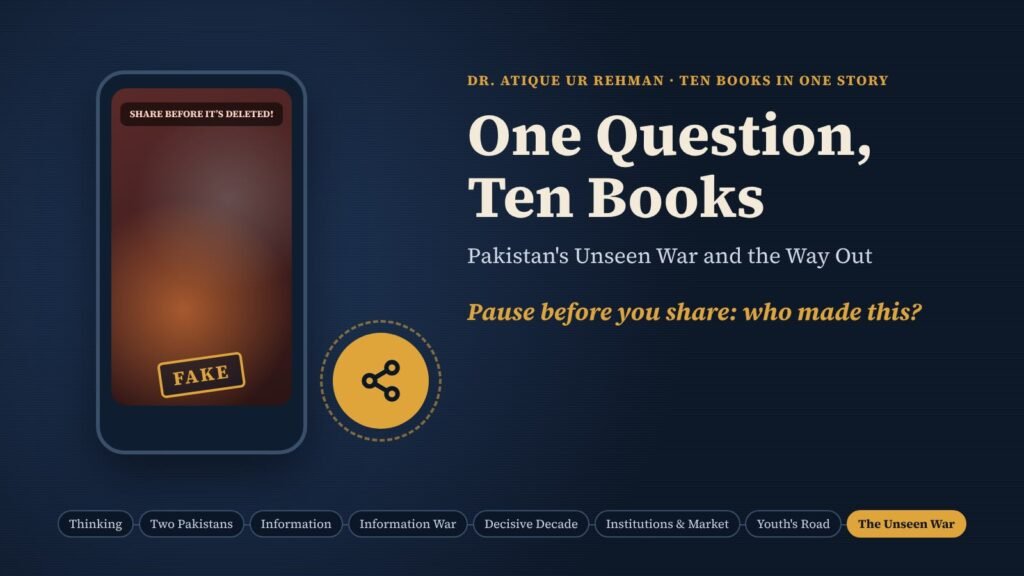
Books give us the frameworks. Daily habits and clear policies turn those frameworks into results. Countering AI and misinformation in Pakistan is not only a job for the government or tech platforms. Citizens, businesses, educators and the media each have a part to play.
For Citizens: Pause Before You Share
- Check the source. Ask who published the content and whether a trusted outlet has reported the same thing.
- Look closely at images, audio and video. AI-generated media often has small errors in hands, text, lighting or lip movement.
- Be most careful with content that makes you angry or afraid. Strong emotion is the fuel that spreads false stories fastest.
- When in doubt, do not forward. Silence is better than amplifying a rumour on WhatsApp or social media.
For Businesses: Protect Your Brand and Your Customers
A single fake video or forged statement can damage a company’s reputation within hours. Businesses should keep official channels verified and active, publish a clear way for customers to confirm genuine announcements, and prepare a response plan before a crisis happens. Internally, set simple rules for how staff use AI tools so that your own content never becomes a source of misinformation.
For Educators and the Media: Build Digital Literacy
Schools and universities can teach students how algorithms rank information, how synthetic media is made and how to verify claims. Journalists can explain their verification process openly, which builds digital trust with audiences. The United Nations guidance on countering disinformation offers useful principles that local institutions can adapt.
For Policymakers: Govern AI Without Silencing Debate
Strong AI governance should protect citizens from manipulation while keeping space for free expression and honest criticism. International references such as the OECD AI Principles and the UNESCO Recommendation on the Ethics of Artificial Intelligence show how transparency, accountability and human rights can sit at the centre of policy. Pakistan can draw on these models while shaping rules that fit its own institutions and languages.
No single step will end AI and misinformation in Pakistan. Together, informed citizens, responsible businesses, careful media and balanced policy can make false information harder to spread and digital trust easier to build.
The Bottom Line
Pakistan’s digital future will not be decided by whether the country adopts artificial intelligence.
That adoption is already happening.
The more important question is:
What kind of information system will develop around it?
One based on speed without verification?
Attention without understanding?
Automation without accountability?
Or one in which AI increases human capability while institutions preserve trust?
Across these ten books, my answer has remained consistent.
Technology should increase agency, not remove it.
AI should amplify judgment, not replace it.
Information should strengthen knowledge, not overwhelm it.
And credibility should remain the foundation on which both institutions and markets operate.
We cannot stop every false claim from being created.
But we can improve the systems that determine whether it is believed.
That is the unseen struggle of the AI era.
And Pakistan has already entered it.
Frequently Asked Questions
How is AI affecting misinformation in Pakistan?
AI makes it easier to generate realistic images, audio, text and video at very low cost. That can increase the speed and scale of misleading content, making verification more important.
What is digital trust?
Digital trust is confidence that a digital source, platform, organization or piece of content is authentic, reliable and accountable.
What is AI governance?
AI governance refers to the rules, responsibilities, technical controls and oversight mechanisms used to manage how AI systems are developed and used.
What is information obesity?
Information obesity is a framework describing a condition in which people consume more information than they can adequately verify, interpret and absorb.
Can AI improve governance in Pakistan?
Potentially. AI can help analyze public-service data, identify recurring complaints and improve service delivery. But government AI systems require safeguards around privacy, accountability, bias and data security.
What is the Liar’s Dividend?
The Liar’s Dividend describes the ability to dismiss authentic evidence as fake because people know convincing synthetic media exists.
How can I tell if a video or image is AI-generated?
Look for small inconsistencies such as distorted hands, unreadable text, unnatural lighting or lip movements that do not match the audio. Then check whether a trusted news outlet or the original source has published the same content. If you cannot confirm it, do not share it.
2 Responses