
Artificial intelligence is becoming part of everyday business operations. From drafting customer emails and creating marketing content to analyzing reports and improving productivity, AI for business offers opportunities that were once available mainly to larger organizations.
But as more employees begin using AI tools, a new challenge emerges: who is responsible when something goes wrong?
Imagine a small business using an AI chatbot to prepare a client proposal. The chatbot generates an incorrect financial figure, and an employee sends the proposal without checking it. The mistake could damage an important client relationship or lead to an expensive misunderstanding.
That is why AI governance for business matters.
You do not need a large compliance department, complicated procedures, or endless meetings to introduce responsible AI practices. For most small businesses, the starting point is much simpler: clear accountability, an inventory of AI tools, sensible risk levels, and regular human review.
This practical guide explains how small businesses can establish effective AI governance without creating unnecessary bureaucracy. It also includes a free one-page AI register template you can begin using immediately.
What Is AI Governance for Business?

AI governance for business means knowing which artificial intelligence tools your company uses, who is responsible for them, what could go wrong, and how potential problems will be identified and managed.
For a small business, effective AI governance requires six basic elements: one accountable owner, a list of approved AI tools, clear risk levels, practical employee rules, human oversight, and regular reviews.
You do not necessarily need an AI committee or consultant. You need a manageable system that helps your employees use AI confidently and responsibly.
Who this guide is for: Owners and managers of businesses with approximately 5 to 200 employees that are already using AI and want better control without excessive paperwork.
What Does AI Governance Mean for a Small Business?
AI governance is the system of responsibilities, policies, controls, and reviews that helps an organization use artificial intelligence safely and accountably.
It goes beyond deciding which AI applications employees are allowed to use.
An AI policy tells employees what they may and may not do. AI governance makes sure those rules are followed, reviewed, and updated when necessary.
Think of the policy as the rulebook and AI governance as the referee, scoreboard, and review after each match.
For example, a small marketing agency might allow employees to use an AI chatbot for brainstorming campaign ideas but prohibit uploading confidential client contracts.
The written policy establishes that rule. Governance assigns someone to approve tools, explain the restrictions, review incidents, and make changes when risks emerge.
This distinction is important because a policy that nobody follows provides little protection.
Why Small Businesses Need AI Governance
Large organizations often have legal teams, IT departments, security specialists, and dedicated compliance officers.
Small businesses usually operate with fewer resources, yet they may face many of the same artificial intelligence risks.
A single mistake can have a serious effect on customer relationships, business operations, and reputation.
One AI Error Can Cost an Important Client
An incorrect figure in an AI-generated proposal, an inaccurate recommendation, or a confidential document shared with an unauthorized tool could create serious problems.
For a business with 20 employees, losing one major client can have a disproportionate financial impact.
Human review and clear accountability help reduce these risks.
AI Use Can Grow Without Anyone Noticing
Employees frequently discover new AI tools while working.
A salesperson may use a chatbot to draft emails, while a marketing employee experiments with an image generator.
Without an AI governance framework, managers may not know which tools employees use or what information is being uploaded.
This untracked use is sometimes called shadow AI.
A simple register can help the business identify and assess these tools.
Clients Are Asking More Questions About AI
Businesses increasingly face questions about how they handle customer information, use automation, and manage third-party technology.
Some larger organizations include AI-related questions in supplier assessments.
Having clear records of approved tools, responsible employees, and review procedures can help a small business provide credible answers.
AI Regulations and Expectations Are Developing
Regulatory developments also make responsible AI use increasingly important.
The European Commission’s AI Act guidance explains how requirements apply to certain AI activities and organizations.
The law can affect some businesses outside the European Union, depending on their activities and the AI systems involved. Selling to an EU customer does not automatically mean every AI Act obligation applies.
A practical governance system can help businesses prepare for requirements relevant to their operations.
Good AI governance is not about slowing innovation. It is about making responsible adoption easier.
The 6 Essential Building Blocks of AI Governance for Business
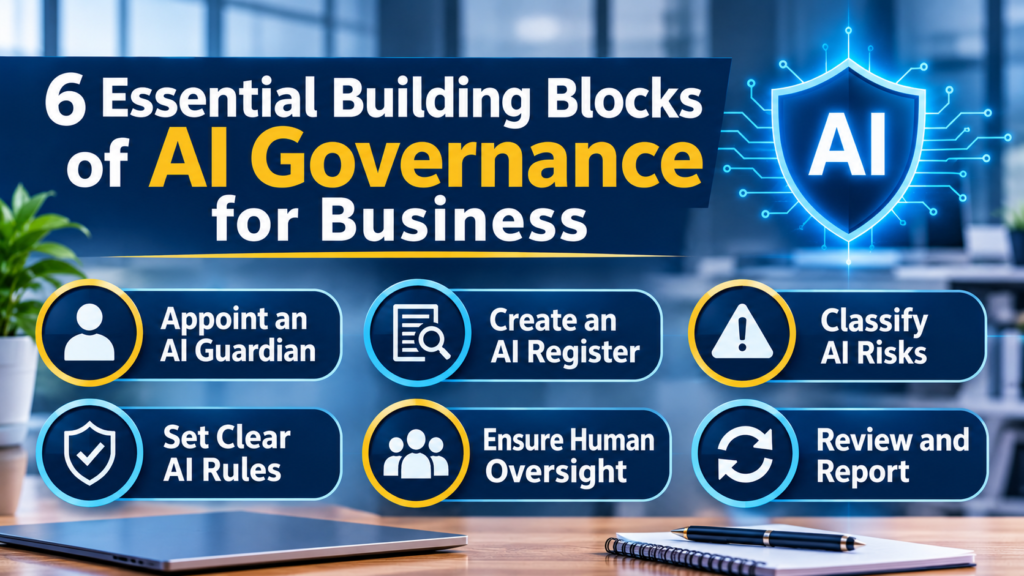
Small businesses can develop an effective AI governance framework without copying the complicated structures used by multinational corporations.
The following six building blocks provide a practical starting point.
1. Appoint One Person Responsible for AI Governance
Every important AI decision should have a named person responsible for it.
In a small business, this might be the owner, operations manager, or a trusted senior employee.
This person does not need to become an artificial intelligence expert.
Their responsibilities should include:
- Approving new AI tools before employees use them.
- Maintaining the company’s AI register.
- Answering employee questions about acceptable AI use.
- Ensuring important risks receive appropriate attention.
- Leading regular governance reviews.
Write the person’s name at the beginning of your AI policy so every employee knows whom to contact.
For example, a 15-person consulting firm might assign responsibility to its operations manager.
The manager would approve new AI applications, maintain records, and ensure client-facing AI content receives appropriate checks.
The essential principle is accountability: AI can support a task, but a person remains responsible for the business decision.
2. Create a Register of Every AI Tool Your Business Uses
You cannot govern tools you do not know exist.
An AI register is a simple document or spreadsheet recording which artificial intelligence tools employees use and why.
Start by asking team members to identify the AI applications they currently use, including free tools and browser-based services.
For each tool, record:
- The name of the AI application.
- The employee or department using it.
- Its business purpose.
- The type of information entered.
- Its risk level.
- The person who approved it.
- The next scheduled review date.
For example, an AI writing assistant may be approved for public marketing content but not for processing confidential customer records.
An AI register makes these boundaries visible.
It also helps managers identify unused tools, unnecessary subscriptions, and applications that require additional controls.
3. Classify AI Risks Into Low, Medium, and High
Not every AI application creates the same level of risk.
Using AI to brainstorm blog titles is different from using AI to screen job applicants or generate financial recommendations.
A practical AI risk management approach separates activities into three categories.
| Risk Level | Typical AI Uses | Required Control |
|---|---|---|
| Low | Brainstorming ideas, internal drafts, rewording public information | Basic rules and appropriate checks |
| Medium | Client emails, marketing materials, business document summaries | Human review before use |
| High | Hiring, pay or credit decisions, legal or financial advice, sensitive personal data | Written owner approval, careful evaluation, and human oversight; prohibit use where appropriate |
These categories are practical internal classifications, not official legal categories under the EU AI Act.
A small business should pay particular attention to activities involving people, money, confidential information, or significant decisions.
For example, AI-generated social media captions may require an ordinary editorial review.
AI-generated assessments of job applicants require much stronger scrutiny and may be inappropriate without specialist advice.
The purpose of risk classification is to focus attention where mistakes could cause the greatest harm.
4. Establish Clear AI Rules Employees Can Follow
An AI governance policy should explain what employees are allowed to do with artificial intelligence.
For most small businesses, a short, understandable document is more useful than a lengthy policy that nobody reads.
Aim for approximately two pages covering:
- Which AI tools are approved.
- Which types of data employees must never upload.
- When human review is required.
- When clients should be informed that AI was used.
- How employees request approval for new AI applications.
- How mistakes or security concerns should be reported.
For example, a company might permit AI tools to summarize publicly available industry research while prohibiting the upload of confidential contracts without specific authorization.
Rules should be practical enough for employees to follow during normal working hours.
5. Require Human Oversight for Important AI Decisions
AI can produce convincing answers that are incomplete, inaccurate, or misleading.
It can also generate inappropriate content or overlook important context.
That is why responsible AI use requires human oversight.
A useful rule is:
AI drafts; people decide.
Anything sent to clients, published publicly, or used in decisions affecting someone’s employment, finances, or other significant interests should be reviewed by a named employee.
For example, an employee might use AI to draft a client proposal.
Before sending it, the responsible employee should verify the financial figures, claims, contractual details, and confidential information.
The business cannot transfer responsibility for those details to the chatbot.
This straightforward practice helps reduce preventable errors while preserving the productivity benefits of AI.
6. Review AI Use Regularly and Make Reporting Easy
AI applications change frequently. Features are added, terms are updated, and employees discover new ways to use existing tools.
As a result, AI governance cannot be completed once and forgotten.
Every quarter, the person responsible for governance should set aside approximately one hour to answer three questions:
- Has anyone started using a new AI tool?
- Has anything gone wrong, or nearly gone wrong?
- Do any rules or approvals need changing?
This quarterly review is a useful baseline, not a reason to delay action when a serious incident occurs.
Employees should also have a simple way to report AI-related mistakes.
For example, someone who accidentally uploads the wrong document to a chatbot should know exactly whom to contact.
A culture of honest reporting allows problems to be addressed earlier.
If employees fear automatic punishment, they may hide mistakes until the consequences become more serious.
Free One-Page AI Register Template for Small Businesses
A small business does not need expensive AI governance software to begin tracking its tools.
The following AI register template can be copied into a spreadsheet or document.
Add one row for every AI application used in the organization.
| AI Tool | Used By | Used For | Data That Goes In | Risk Level | Approved By | Next Review |
|---|---|---|---|---|---|---|
| Business chatbot (paid plan) | Sales team | Drafting client emails | Client names, no contracts | Medium | Owner | [Date] |
| Free image generator | Marketing | Social media images | Public prompts only | Low | Owner | [Date] |
| [Tool] | [Team or person] | [Task] | [Type of data] | [Low / Medium / High] | [Name] | [Date] |
How to Use the AI Register
The register works best when it becomes part of everyday business operations.
First, add an entry before anyone begins using a new AI tool for company work. No approved entry means no authorized use.
Second, require written approval from the designated owner for high-risk AI activities.
Third, review the register every quarter and remove or archive tools that the company no longer uses, while retaining records required by applicable policies or obligations.
The document does not need to be complicated.
Even a one-page register can help the organization answer basic questions about which AI tools it uses, who approved them, and what information they process.
My View: Accountability Beats Paperwork
In any well-run organization, every important responsibility should have a person who answers for the outcome.
That principle matters more than the number of policies a business produces.
Small business owners sometimes assume that AI governance requires lengthy documents, formal committees, or specialist departments.
In practice, clear ownership, honest reporting, and regular review provide a much better starting point.
The smaller the organization, the more important it becomes for people to understand their responsibilities.
A one-page AI register that employees actually maintain can be more useful than a hundred-page manual nobody reads.
Common AI Governance Mistakes Small Businesses Should Avoid
Even a simple governance framework can fail when businesses overlook basic responsibilities.
Treating AI Governance as a One-Time Project
Creating a policy is only the beginning.
Schedule quarterly reviews to ensure tools, approvals, and rules remain relevant.
Leaving Everything to the IT Department
AI risks are not exclusively technical.
They affect customers, employees, finances, reputation, and business decisions.
The business owner or designated senior manager should remain involved.
Applying the Same Controls to Every AI Tool
Not every application requires the same degree of oversight.
Focus greater attention on high-risk activities while keeping low-risk uses manageable.
Banning AI Instead of Managing It
A blanket ban may encourage some employees to use unapproved tools without informing management.
Clear rules and approved alternatives can be more effective, although certain uses should be prohibited when risks cannot be adequately managed.
Failing to Record Important Decisions
If a customer asks why a particular AI application was approved, the business should be able to explain its decision.
A maintained AI register provides a practical record of responsibilities and approvals.
Trusting AI Vendors Without Asking Questions
Many small businesses assume that a well-known AI tool is automatically safe to use. That is a risky assumption. Before you add a new tool to your workflow, ask the vendor where your data is stored, whether your inputs are used to train their models, and how you can delete your information if you stop using the service.
Record the answers in your AI register next to the tool name. If a vendor cannot give clear answers, treat the tool as high risk until you know more. Good AI governance for business does not mean avoiding vendors. It means choosing them with your eyes open and keeping a simple record of why you trust each one.
Your Next Steps: Put AI Governance Into Practice
Introducing AI governance for a small business does not need to become a complicated transformation project.
Start with four practical actions:
- Name your AI owner today. Assign responsibility to a trusted employee or manager and inform the team.
- Create your AI register this week. Record the AI tools employees already use and assess their risks.
- Write a short AI use policy. Define acceptable tools, prohibited data, and human review requirements.
- Schedule your first quarterly review. Set aside one hour to examine new tools, incidents, and necessary changes.
The NIST AI Risk Management Framework also provides voluntary guidance for organizations seeking to understand and manage AI-related risks.
You do not need to implement every element of a formal enterprise framework to make a meaningful start.
What matters is building a governance process proportionate to your company’s size, activities, and risks.
Effective AI governance for business is not about creating more paperwork. It is about making sure someone is responsible, important decisions are checked, and problems are addressed before they become costly.
Have a question about AI governance in your business? Leave it in the comments below, and I will answer it.
About the Author
Dr. Atique Ur Rehman is the founder and CEO of Digital and AI Solutions (DAIS) and a retired military officer with UN peacekeeping experience. He is the author of more than 20 books on geopolitics, governance, and AI, including The Sovereign Inforg, Future of Humanity, and New Information Order.
He holds a PhD in International Relations and writes for The Nation and Daily Times.